
Electrical repairs
AC Capacitor Repair
- Run + start capacitors
- Heat-driven failure
- Cape Coral, FL
Quick answer
A humming outdoor unit, a fan that won't spin, or a compressor that struggles to start are the classic signs of a failed AC capacitor — a small component that delivers the electrical push a motor needs to overcome its own starting resistance.
Capacitors store a charge that remains dangerous even with the unit powered off, so testing and replacement should always be handled by a technician, not attempted at the panel yourself.
What a capacitor does
AC motors — the compressor and the condenser fan — need a burst of extra electrical push to start turning from a standstill. A run capacitor stores a charge and releases it to shift the current phase feeding the motor's start winding, effectively giving it the torque needed to get moving, then continues smoothing current delivery for as long as the motor runs. Many residential systems use a single dual-run capacitor that serves both the compressor and the fan motor from separate terminals on the same can.
Some compressors also use a start capacitor paired with a start relay, providing a larger, brief boost during the first fraction of a second of startup only, then dropping out of the circuit once the motor is up to speed. Whichever type is installed, the job is the same: get a heavy motor moving against its own mechanical and magnetic resistance.
Symptoms of a failing capacitor
- Humming with no movement. The compressor or fan motor draws power and hums but never spins. Without enough starting torque, the motor sits at a stall point, drawing high current and generating heat with nothing to show for it.
- Hard starting. The fan or compressor eventually catches and spins, but only after a noticeable delay or shudder, rather than a clean immediate start.
- Fan not spinning. The condenser fan sits motionless while the compressor runs, or vice versa, especially common with dual-run capacitors where one leg has degraded more than the other.
- Breaker trips on startup. A motor straining against a weak or dead capacitor can pull enough locked-rotor amperage to trip the breaker at the exact moment the system tries to start.
Heat: the primary killer in Florida
Capacitors fail primarily from heat exposure over time. The dielectric material inside gradually breaks down under sustained high temperature, and the capacitor's microfarad rating drifts downward — it can still hold some charge while no longer delivering enough of a starting boost. Cape Coral's near-continuous cooling season means condensers accumulate far more running hours per year than the same equipment would see in a milder climate, and the outdoor unit sits exposed to direct afternoon sun on top of the heat it generates internally. That combination shortens capacitor life considerably compared to units running fewer hours in cooler ambient conditions.
Why capacitors are not a DIY part
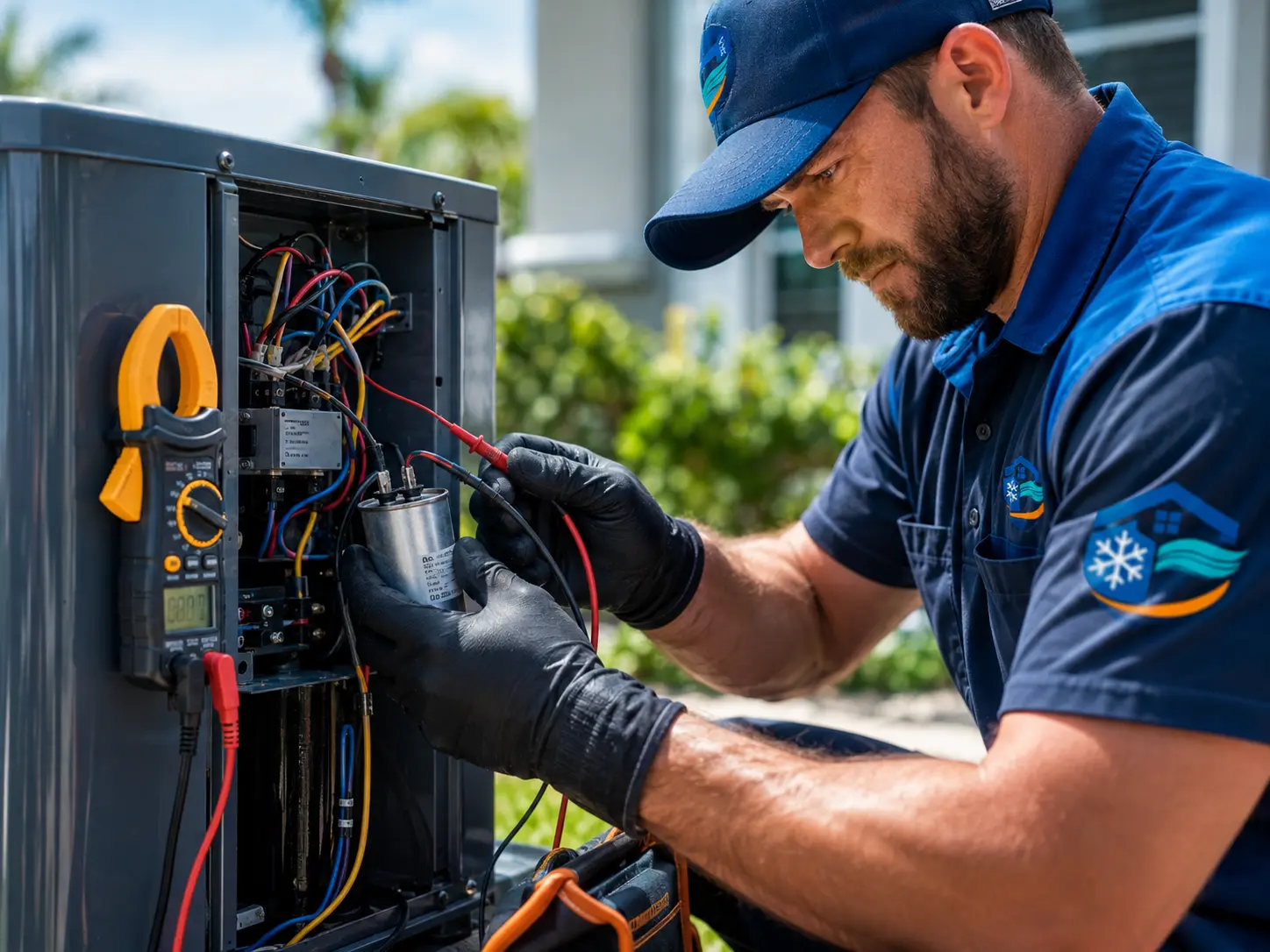
A capacitor stores an electrical charge independent of the unit's power supply. Even with the breaker off and the disconnect pulled, a capacitor can retain enough charge to deliver a serious — potentially lethal — shock if it's touched or shorted incorrectly. Technicians discharge a capacitor safely before handling it and use a meter to test its microfarad rating against the value printed on the case, replacing it with a correctly rated part matched to the motor it serves. This isn't a part to test or swap at the breaker panel yourself.
What else a failed capacitor stresses
A motor forced to start repeatedly without adequate capacitor support draws elevated amperage on every attempt. That extra current heats motor windings beyond their design tolerance and pits contactor contacts faster than normal wear would. Left long enough, a five-minute capacitor swap can turn into a burned contactor or, in the worst case, a damaged compressor winding — which is why addressing capacitor symptoms early matters.
Frequently asked questions
01What does an AC capacitor actually do?
A run capacitor stores and releases an electrical charge to give the compressor and condenser fan motor the extra push they need to start spinning, then keeps their current smooth while they run. A start capacitor, used on some compressors, provides an even larger momentary boost during startup only. Without a working capacitor, an AC motor often can't overcome its own starting inertia.
02Can I test or replace a capacitor myself?
No. A capacitor stores an electrical charge and can deliver a dangerous — potentially lethal — shock even after the power to the unit has been switched off. Testing microfarad rating and replacing the part correctly requires a meter, a proper discharge procedure, and knowledge of the wiring terminals. This is technician work.
03What are the warning signs of a failing capacitor?
A humming sound from the outdoor unit with the fan not spinning, a compressor that hums but won't start, a fan that needs a push (with a stick, never your hand) to get going, longer-than-normal startup, or a breaker that trips when the system tries to start. Any of these point to a capacitor near the end of its life.
04Why do capacitors fail so often in Cape Coral?
Heat is the primary killer of capacitors, and Cape Coral condensers sit in direct sun through the hottest part of the day for most of the year. Heat accelerates the breakdown of the dielectric material inside the capacitor, gradually reducing its microfarad rating until it can no longer deliver enough of a starting boost. Long run times common in Florida's cooling season add to the cumulative heat exposure.
05What happens if a weak capacitor isn't replaced?
A motor that's straining to start on a weak capacitor draws higher amperage every cycle. That extra current stresses windings, contactor contacts, and the compressor itself, and can shorten the life of components well beyond the capacitor. What starts as a fifteen-minute capacitor swap can escalate into a compressor replacement if it's ignored.
06Is microfarad testing different from just looking at the capacitor?
Yes. A capacitor can look physically normal — no bulging, no leaking — and still have drifted well outside its rated microfarad value. A meter reading against the rated value stamped on the case is the only reliable way to confirm whether a capacitor is within tolerance or needs replacement.
07Does a bulging or leaking capacitor always mean failure?
A visibly bulged top, a cracked case, or oily residue around the base are physical signs of a capacitor that has already failed or is failing, usually from internal pressure buildup due to heat and age. That said, plenty of failed capacitors show no visible damage at all, which is why electrical testing matters more than appearance.
Related repair services
Related symptoms
Where we publish AC repair information
Cape Coral, FL
Outdoor unit humming but not spinning?
That's a classic capacitor symptom. Get it tested and replaced correctly rather than risking a shock at the panel.