System education
How a Central AC System Works
- Refrigeration cycle
- Component-by-component
- Cape Coral, FL
Quick answer
A central AC system moves heat out of your house using a sealed refrigerant circuit, a blower that pushes air across it, and an outdoor unit that rejects the heat outside. Every major component has one specific job, and a failure in any one of them shows up as a recognizable symptom.
Understanding the cycle and the parts makes it much easier to follow what a technician is telling you, and why one small failed part can stop a whole system.
The refrigeration cycle
Four steps, one loop
Refrigerant never leaves the system under normal operation — it cycles continuously through four stages, changing state and pressure each time:
- Evaporation. Inside the evaporator coil, low-pressure liquid refrigerant absorbs heat from the warm household air passing over it and turns to vapor. This is where the actual cooling of your air happens.
- Compression. The compressor pulls in that low-pressure vapor and squeezes it, raising both its pressure and temperature so it's hotter than the outdoor air.
- Condensation. The hot, high-pressure vapor flows to the outdoor condenser coil, where outdoor air pulled across it by the condenser fan carries the heat away, condensing the refrigerant back into a liquid.
- Expansion. The metering device forces that high-pressure liquid through a small opening, dropping its pressure and temperature sharply before it re-enters the evaporator coil to start the cycle again.
Every part of the system exists to support one of these four steps or to move air and control the process safely around them.
Component index
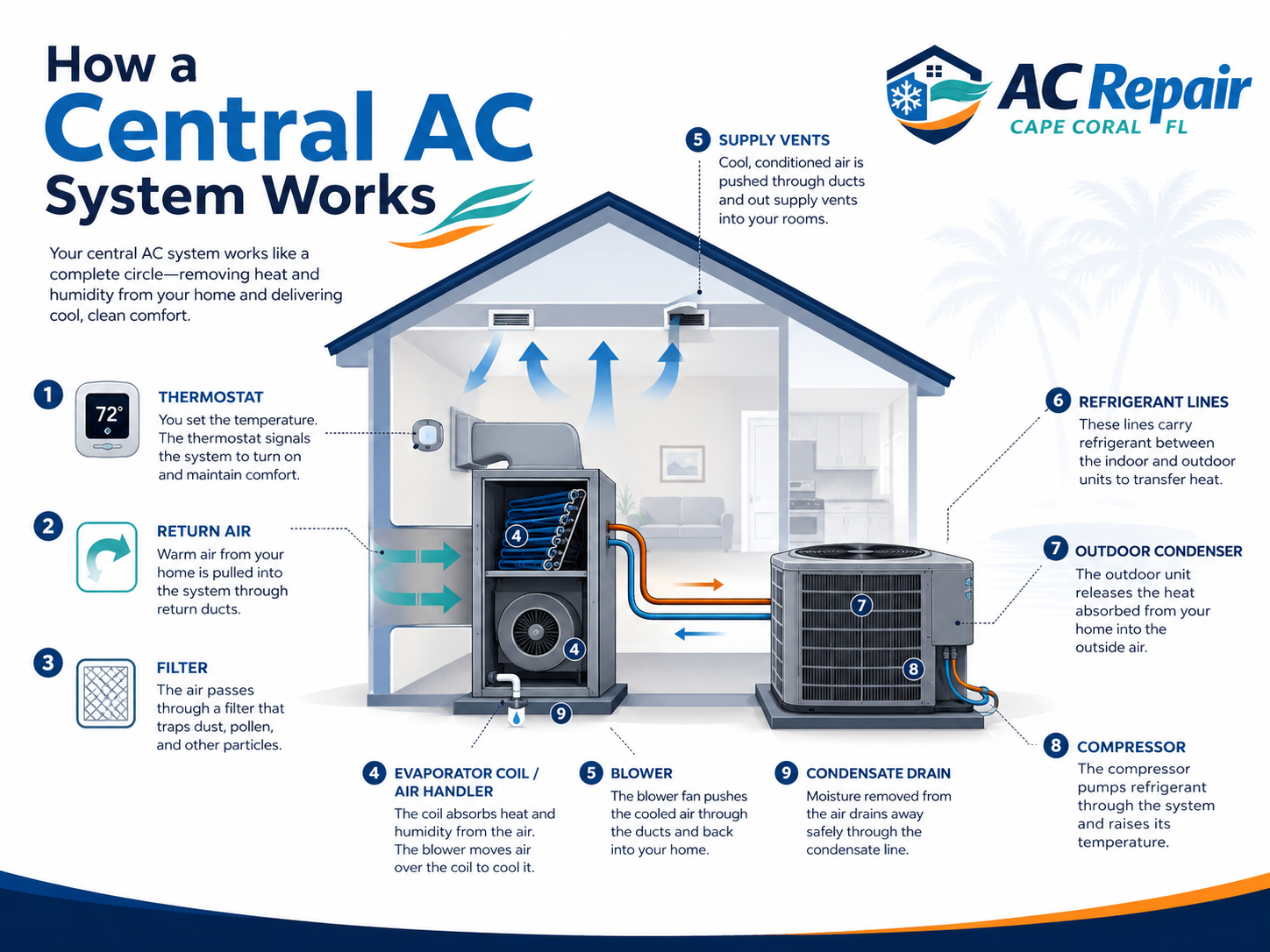
Every part, its job, its failure mode
Thermostat
JobReads room temperature and sends a call for cooling to the equipment.
Fails asMiscalibration, wiring faults, or placement in direct sun/near a supply vent causing bad readings and short cycling.
Return ducts
JobPull warm household air back to the air handler to be cooled and recirculated.
Fails asBlocked or undersized returns starve the whole system of airflow, contributing to icing and weak cooling.
Filter
JobRemoves dust and debris from return air before it reaches the coil and blower.
Fails asLoading up restricts airflow, the single most common cause of frozen coils and weak cooling.
Evaporator coil
JobAbsorbs heat from indoor air as refrigerant evaporates inside it, cooling and dehumidifying the airstream.
Fails asRestricted airflow or low charge drops coil temperature below freezing; dirt fouling reduces heat transfer.
Blower
JobMoves air across the evaporator coil and through the duct system into the house.
Fails asA weak or failing motor reduces airflow, which mimics or causes many of the same symptoms as a dirty filter.
Metering device / TXV
JobCreates a pressure drop that lets refrigerant expand and cool, and meters flow into the evaporator.
Fails asA stuck or worn valve causes poor cooling, abnormal pressures, or icing even with a correct refrigerant charge.
Line set
JobCopper piping that carries refrigerant between the indoor coil and outdoor condenser.
Fails asRubbing, vibration, or corrosion can wear a pinhole leak that slowly drains the system's charge.
Compressor
JobPressurizes refrigerant vapor, raising its temperature so it can reject heat outdoors.
Fails asElectrical winding failure or mechanical seizure, often accelerated by low charge, restricted airflow, or electrical strain.
Condenser coil
JobRejects the heat the refrigerant is carrying to the outdoor air.
Fails asDirt, grass clippings, or corrosion from salt air reduce heat rejection, raising pressures and stressing the compressor.
Condenser fan
JobPulls outdoor air across the condenser coil to carry heat away.
Fails asA failed motor or capacitor stops airflow across the coil, causing high pressures and potential safety shutdowns.
Contactor
JobA relay that switches line voltage to the compressor and condenser fan on a call for cooling.
Fails asPitted or burned contacts can fail to close, leaving the outdoor unit silent while the indoor blower still runs.
Capacitors
JobStart and run capacitors give the compressor and fan motors the electrical push they need to start and keep running smoothly.
Fails asA weakened capacitor causes hard starting, humming without spinning, or a motor that won't start at all.
Condensate drain
JobCarries the water condensed out of the air on the evaporator coil safely outside.
Fails asAlgae and debris clog the line, backing water up into the pan and eventually the house.
Safety switches
JobFloat switches and pressure switches shut the system down before water overflow or unsafe pressures cause damage.
Fails asTripping is often correctly protecting the system; the underlying drain or pressure problem still needs fixing.
Why it matters here
Sensible vs. latent cooling in Florida
Cooling does two separate jobs. Sensible cooling lowers the air's temperature — what a thermostat measures. Latent cooling removes moisture from the air as it passes over the cold evaporator coil, condensing water vapor into the condensate that runs down the drain line.
In a dry climate, sensible cooling dominates and a system can satisfy the thermostat quickly. In Cape Coral, outdoor humidity is high most of the year, so a meaningful share of the system's total capacity goes into latent cooling — pulling moisture out of the air, not just lowering its temperature. That's why a house can read the correct temperature on the thermostat and still feel damp and uncomfortable if the system isn't running long enough cycles to do the latent work, or if it's oversized and satisfies the thermostat too quickly to dehumidify properly.
It's also why condensate volume is so high locally, and why drain line maintenance matters more here than in drier regions — the coil is wringing moisture out of the air almost continuously through the cooling season.
Frequently asked questions
01Why does my system need refrigerant if it doesn't get 'used up'?
Refrigerant circulates in a sealed loop and shouldn't be consumed at all. If a system is low, it has a leak somewhere in the coils, line set, or a connection joint. Adding refrigerant without fixing the leak just means it will run low again.
02What's the difference between sensible and latent cooling?
Sensible cooling lowers air temperature; latent cooling removes moisture from the air. In Cape Coral's humid climate, a meaningful share of the system's total work goes into latent cooling, which is why a house can feel humid and uncomfortable even when the thermostat shows the right temperature.
03Why does the compressor get so much attention in a diagnosis?
It's the only moving mechanical part in the sealed refrigerant circuit and the most expensive component to replace. It's also the one most affected by problems elsewhere in the system — low refrigerant, restricted airflow and electrical faults all put extra stress on the compressor over time.
04What does the metering device actually do?
It creates a precise pressure drop that lets refrigerant expand and cool before entering the evaporator coil, and it meters the exact amount of refrigerant flow the system needs for current conditions. A stuck or worn metering device causes poor cooling, icing or high pressures even with a full refrigerant charge.
05Why does the condenser fan matter so much?
It pulls outdoor air across the condenser coil to reject the heat the refrigerant is carrying. If that fan fails or the coil is dirty, the system can't shed heat properly, pressures climb, and the compressor works harder and runs hotter than it should.
06Does a bigger system cool a humid house better?
Not necessarily. An oversized system satisfies the thermostat's temperature setting quickly but runs in short bursts, which doesn't give it enough runtime to pull humidity out of the air. Properly sized equipment that runs longer, steadier cycles usually controls humidity better in Florida's climate.
Related repair services
Related symptoms
Where we publish AC repair information
Cape Coral, FL
Want a technician's read on your specific system?
Describe the symptom and get a plain explanation of which component is likely behind it.