Runs but doesn't cool
AC Not Cooling: System Runs, House Stays Warm
- Location: Cape Coral, FL
- Phone: 239-423-5617
- Symptom: Running, not cooling
Quick answer
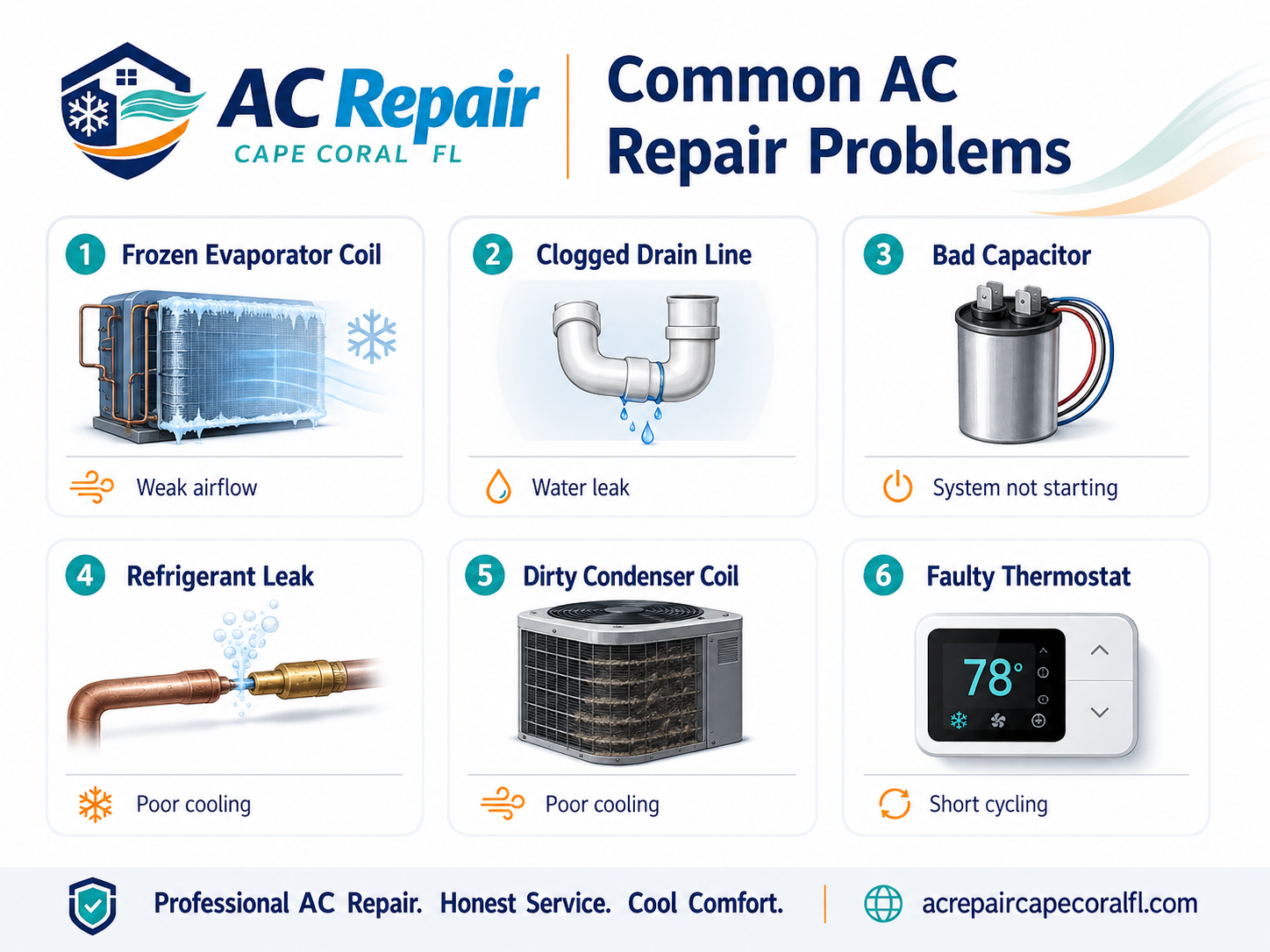
When the blower runs but the house doesn't cool, the problem is almost always reduced heat transfer somewhere along the airflow or refrigerant chain — not a system that's "off." The likely causes are a restricted filter or return, a dirty or frozen coil, low refrigerant charge, or a failing capacitor limiting the condenser fan or compressor.
The airflow chain
Where airflow gets lost
Cooling depends on moving a large, steady volume of house air across a cold evaporator coil. Anything that restricts that path reduces how much heat the system can pull out of the air, even if every mechanical part is otherwise healthy. The chain runs from return grilles, through the filter, across the blower, through the coil, and out the supply ducts to each room.
Filter
A loaded filter is the single most common airflow restriction. In Cape Coral's dusty, humid conditions filters load faster than in drier climates. A restricted filter starves the coil of air, drops coil temperature below normal, and can lead directly to coil icing, which restricts airflow even further.
Returns
Closed doors to rooms with no dedicated return, furniture or rugs blocking a return grille, or an undersized return duct all limit how much air the blower can pull back into the system. Symptoms often show up as uneven cooling — some rooms fine, others warm — as much as whole-house underperformance.
Evaporator coil
Even with good airflow reaching it, a coil coated in dust, biofilm, or fouled fins resists heat transfer. A partially frozen coil is worse: ice acts as insulation and physically blocks the fin spacing air needs to pass through, so cooling capacity drops even as the blower keeps running normally.
Refrigerant and condenser
When the refrigerant circuit is the cause
Refrigerant charge and condenser condition work together. If the charge has dropped from a leak, the coil can't absorb heat at its designed rate, and the whole system's cooling capacity falls even though the compressor and blower are both running. A system slowly losing charge often shows a gradually shrinking temperature split over weeks or months before it becomes an obvious failure.
On the outdoor side, the condenser coil has to reject the heat the refrigerant carried from inside the house. Dirt, grass clippings, or salt residue on the fins reduce that heat rejection, which raises head pressure and reduces overall capacity — a particular risk near Cape Coral canals where salt-laden air accelerates buildup and corrosion on outdoor coils.
Capacitor and temperature split
What a technician measures, and why
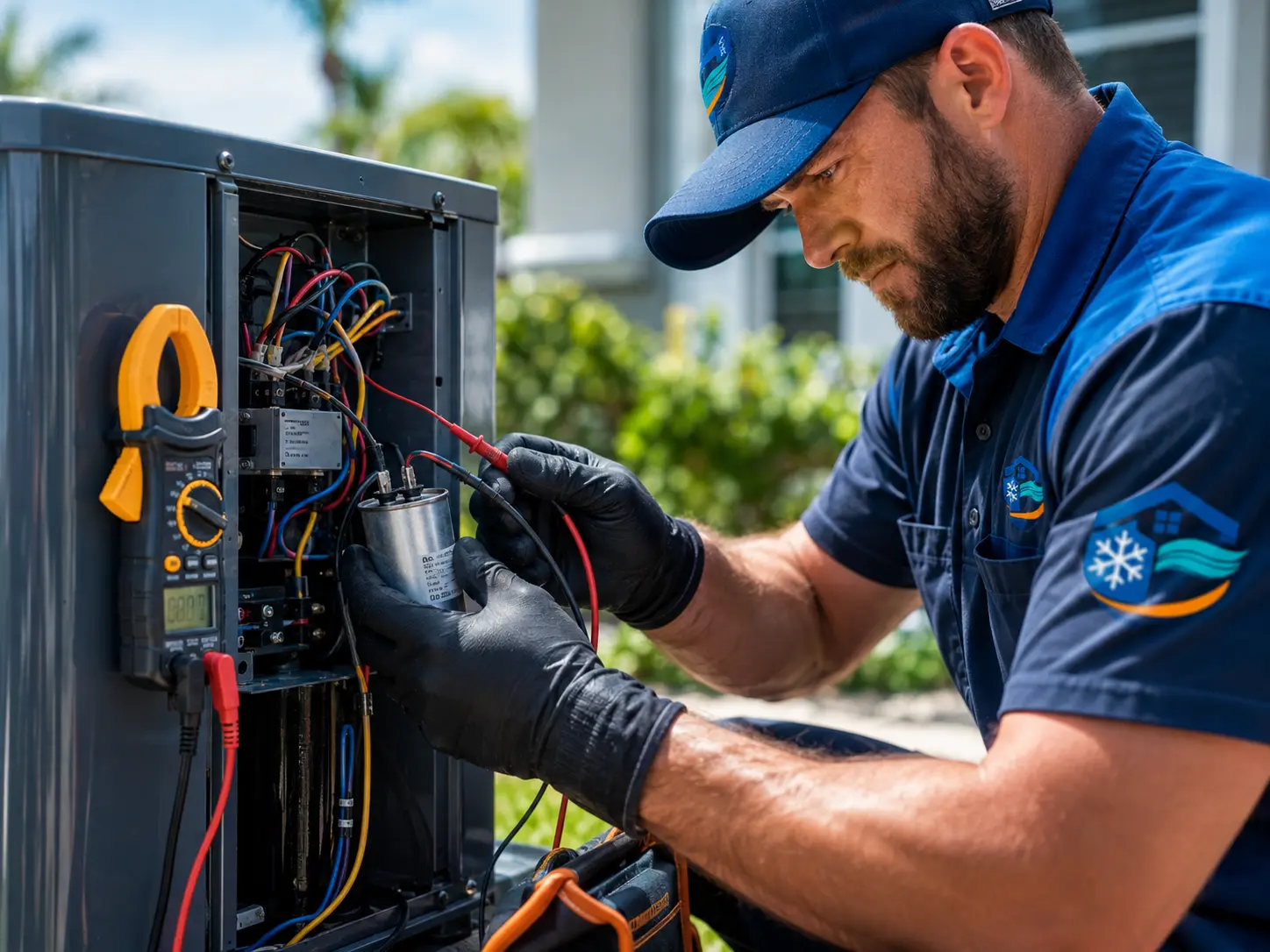
A failing run capacitor can leave the condenser fan spinning slowly, humming without starting, or not running at all. Without full condenser fan speed, the outdoor coil can't reject heat efficiently, and cooling capacity drops across the whole system even with a fully charged refrigerant circuit and a clean filter.
Temperature split is the core diagnostic number a technician relies on: the difference between return air temperature and supply air temperature. A split that's smaller than expected for the humidity and airflow conditions suggests the coil isn't absorbing heat effectively — pointing toward low charge, a fouled coil, or a condenser problem. A split that's larger than expected alongside weak airflow can indicate the coil is starting to ice over. Measuring it, rather than guessing from how the air "feels," is what turns a vague complaint into an actionable diagnosis.
Frequently asked questions
01Why does my AC run constantly but never cool the house?
Constant running with insufficient cooling usually points to reduced heat transfer somewhere in the chain: a loaded filter, a dirty condenser coil, low refrigerant charge, or a partially frozen evaporator coil. The blower keeps moving air, but the air isn't being cooled enough on each pass.
02What is temperature split and why does it matter?
Temperature split is the difference between the air entering the return and the air leaving the supply registers. A properly working system typically produces a split in a expected range for the conditions. A split that's too small suggests the coil isn't absorbing heat well; too large a split, especially with reduced airflow, points toward airflow restriction and coil icing risk.
03Can a dirty air filter really stop my AC from cooling?
Yes, and it's one of the most common causes. A loaded filter restricts air moving across the evaporator coil, which drops airflow, lowers the coil's temperature, and can lead to ice forming on the coil, which further blocks airflow.
04How do I know if my returns are the problem?
Closed interior doors, furniture blocking a return grille, or an undersized return duct all starve the system of the air volume it needs. If closing doors in parts of the house coincides with worse cooling, the return path is worth checking.
05Does a dirty condenser coil affect indoor cooling?
Yes. The condenser coil rejects the heat the system collected indoors. If it's coated in dirt, grass clippings, or salt residue, it can't reject heat efficiently, which raises system pressures and reduces the whole system's cooling capacity.
06Could low refrigerant be the cause even without visible ice?
Yes. A system can run low on charge without freezing yet, especially early in a leak. Reduced capacity, longer runtimes, and a smaller temperature split without any airflow-related cause point toward a refrigerant issue that needs pressure testing.
07Is it my capacitor if the outdoor fan runs slow or not at all?
A weak or failed run capacitor is a common reason a condenser fan spins slowly, hums without starting, or doesn't run at all. A stopped or slow condenser fan reduces heat rejection and drops cooling capacity system-wide.
Related repair services
Related symptoms
Cape Coral, FL
Your AC shouldn't be a guessing game.
Describe what the system is doing and get a straight explanation of what needs to happen next.