
AC repair cost factors
What Actually Affects AC Repair Cost
- No price guessing
- Diagnosis first
- Cape Coral, FL
Quick answer
AC repair cost is driven by which component failed, how the system is built, how old it is, how hard it is to reach, and how much refrigerant and labor the fix requires. None of that is knowable from a phone description alone.
This page explains every variable that moves cost so you can ask better questions and compare repair options fairly — without a single dollar figure, because an honest one doesn't exist before diagnosis.
Why no number up front
A price before diagnosis is a guess
"AC not cooling" can mean a five-minute capacitor swap or a multi-step refrigerant leak repair. "Water at the air handler" can mean a clogged drain line or a cracked drain pan. The symptom you observe from inside the house doesn't tell you which component actually failed — that only becomes clear once a technician measures voltage, pressures, temperatures, and airflow and traces the fault to its source.
Any number quoted before that diagnostic work happens is necessarily a guess, whether or not it's presented that way. It has to assume a specific failure, a specific part, and a specific amount of labor, and if any of those assumptions is wrong, the number was wrong too. That's why the honest answer to "how much will this cost" is "it depends on what we find," followed by a specific, itemized explanation once the diagnosis is complete.
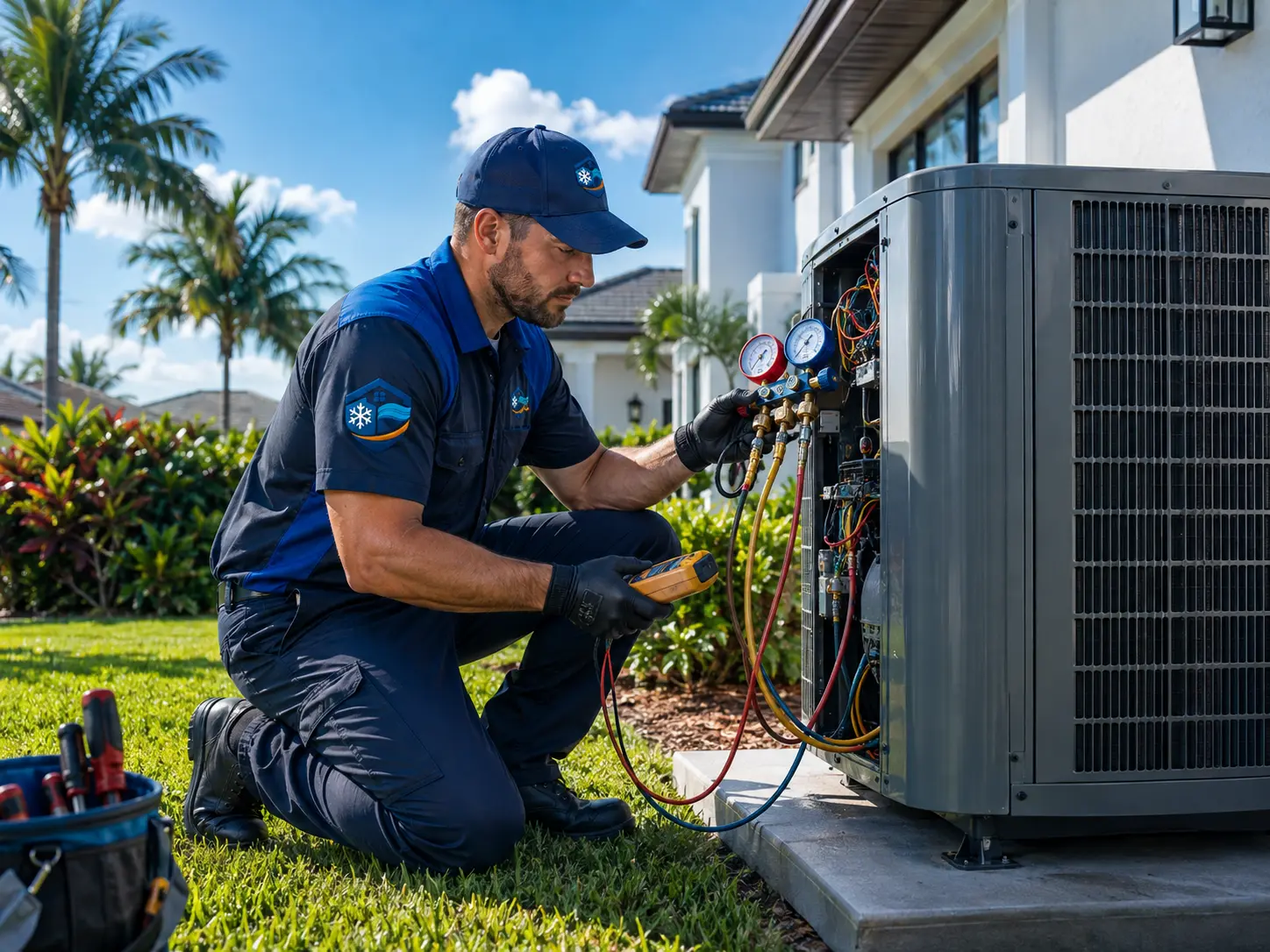
The variables
Nine things that move the scope
These are the factors a technician is actually weighing when they scope a repair. Understanding them helps you ask sharper questions and recognize a thorough diagnosis when you see one.
Which component failed
A capacitor, contactor, or run capacitor is a small, commonly stocked part that takes a technician minutes to test and swap. A compressor, control board, or evaporator coil sits at the other end of the spectrum — larger, more expensive to source, and more involved to remove and reinstall. The failed component is the single biggest driver of scope, because it determines what has to be ordered, how long the job takes, and whether the system needs to be opened, evacuated, or recharged afterward.
System type and configuration
A straightforward split system with an easily accessed air handler is a different job than a packaged unit, a heat pump with reversing valve components, or a system tied into zoned ductwork with multiple dampers and an extra control board. More components and more integration points mean more places a fault can hide, and more steps to confirm the fix actually resolved the problem.
Age and part availability
Systems installed within the last several years usually use parts that are stocked at nearby supply houses, so a technician can often source a replacement part quickly. Older systems, discontinued model lines, and less common brands sometimes need a part sourced from a regional warehouse or ordered directly from the manufacturer, which affects both timeline and, at times, whether an exact match is even still manufactured versus a compatible substitute.
Diagnostic complexity
Some failures are obvious the moment a technician opens the disconnect — a visibly bulged capacitor, for instance. Others require systematic elimination: checking voltage at multiple points, testing a compressor's winding resistance, pressure-testing the refrigerant circuit, or tracing a wiring fault through the low-voltage control circuit. A symptom with several possible causes takes longer to isolate than one with an obvious single cause, and that diagnostic time is real work regardless of how small the eventual part turns out to be.
Refrigerant type and quantity
Different systems use different refrigerants, and the type installed in your system depends on when it was manufactured. Recovery, evacuation, and recharging a refrigerant circuit takes equipment, certification, and time, and the amount of refrigerant a system holds scales with its capacity and line length. A leak also has to be found and repaired before refrigerant is added back, since simply refilling a leaking system treats a symptom rather than the cause.
Accessibility of the equipment
An air handler in a walk-in interior closet is easy to work on. The same equipment tucked into a low attic, behind stored belongings, or in a tight coastal-home mechanical closet with limited clearance takes longer to reach, and can require extra care to avoid damaging surrounding materials. Outdoor condensers wedged against a fence line, buried in landscaping, or elevated on a stand for flood consideration also take longer to service safely than a unit with open clearance on all sides.
Labor scope and return visits
Some repairs are single-visit: diagnose, replace, verify, done. Others require a return trip — for example, when a part has to be ordered, or when a system needs to run for a period after a repair to confirm the fix holds before further work is authorized. A leak repair followed by evacuation and recharge is also often sequenced across steps rather than compressed into one continuous task, which affects how the labor is scoped.
Timing: daytime, after-hours, or emergency
Routine daytime scheduling lets a technician plan a visit as part of a normal route. A call placed after hours, overnight, or on a holiday requires different scheduling and dispatch, and that timing is a legitimate variable in how a visit is structured. Ask directly how after-hours calls are handled before committing to one, since terms vary.
Warranty status
A system still within its manufacturer parts warranty may have the cost of certain replacement components covered, but warranty coverage is specific: it usually applies to the part itself, sometimes requires proof of registration or original installation records, and doesn't always include the labor to diagnose and install the part. Confirm exactly what's covered, for how long, and under what conditions before assuming a repair is included.
Comparing fairly
How to compare repair options fairly
If you're weighing more than one technician's assessment, the useful comparison isn't which number is lower — it's whether the diagnosis and scope actually match. Ask each one:
- What specific component did you find failed, and how did you confirm it?
- Is this a single-visit repair, or does it require a part order or return trip?
- If refrigerant is involved, was a leak located, or is this a recharge only?
- Does this system's warranty status apply to any part of this repair?
- What would happen if this component isn't replaced now?
Two assessments that name the same failed part and the same scope of work are genuinely comparable. Two assessments that describe different failures or different scopes aren't comparable at all — you're not choosing between two prices, you're choosing between two different diagnoses, and the accuracy of the diagnosis matters more than which one costs less.

Frequently asked questions
01Why won't anyone give a number over the phone?
Because the same symptom can have several different causes, each with a different scope. A system 'not cooling' could be a capacitor, a refrigerant leak, or a failed control board — three completely different repairs. A number given before diagnosis is a guess dressed up as a quote.
02Does the brand of my system change the cost picture?
Brand itself matters less than age and part availability. A newer, mainstream system usually has parts on hand at local supply houses. An older or less common brand may require a special order, which affects timeline more than it affects the nature of the repair.
03Is it worth getting more than one estimate?
Yes, as long as you're comparing like for like. Ask each technician what they found, what they're proposing to fix, and why. A comparison based only on a final figure, without knowing whether the diagnosis and scope match, isn't a fair comparison.
04Why does the same repair sometimes take longer on one visit than another?
Access and complexity vary house to house. A capacitor in an easily reached disconnect box takes minutes. The same part behind a packed attic air handler, or one requiring a panel to be partly disassembled, takes longer, and labor time is part of the scope.
05Does calling after hours really change anything?
It can. Emergency and after-hours work often carries different scheduling and labor terms than routine daytime appointments, since it requires reshuffling a schedule or dispatching outside normal hours. Ask directly how a technician structures after-hours visits before agreeing to one.
06If my system is still under warranty, is the repair free?
Not necessarily. Manufacturer warranties typically cover the part itself, not always the labor to diagnose and install it, and coverage terms vary by manufacturer, registration status, and system age. Confirm exactly what a warranty covers before assuming the whole repair is included.
07Why did the technician recharge refrigerant on one visit and find a leak on another?
Refrigerant should never just be topped off without explanation — a system that's low on charge has a leak somewhere, since it's a sealed system in normal operation. A responsible diagnosis identifies the leak; simply adding refrigerant without finding it only delays the real repair.
Related repair services
Related symptoms
Where we publish AC repair information
Cape Coral, FL
Get a real diagnosis, not a guess.
Describe the symptom and get a straight, itemized explanation of what's actually wrong before any repair scope is proposed.