
Controls + Airflow
Thermostat Repair
- Blank display
- Wrong readings
- Short cycling
Quick answer
A blank display, a temperature reading that doesn't match the room, or a system that starts and stops too often can all trace back to the thermostat — power supply, sensor placement, low-voltage wiring, or a compatibility mismatch on a smart replacement. Some of that is diagnosable by testing the equipment directly; the rest needs eyes on the wiring behind the wall plate.
Blank display or unresponsive controls
A thermostat that shows nothing at all has lost its power source. Battery-powered models simply need fresh batteries, but most modern thermostats — especially smart models — draw power from the system's low-voltage transformer through a C-wire. A tripped breaker at the air handler, a blown low-voltage fuse on the control board, or a loose or corroded wire nut behind the thermostat plate can all cut that power.
If the breaker is fine and batteries aren't the issue, the fault is usually inside the air handler: a failed transformer, a shorted low-voltage wire somewhere in the run, or a control board that has stopped supplying voltage to the thermostat circuit.
Reading the wrong temperature
A thermostat measures the air immediately around its own sensor, not the room as a whole. If it's mounted in direct afternoon sun, near a supply register blowing conditioned air directly on it, or on an exterior wall that picks up outdoor heat, the reading it reports can be several degrees off from what the rest of the room actually feels like. That mismatch causes the system to satisfy too early or run longer than the space needs.
A genuinely miscalibrated internal sensor is less common but does happen, particularly on older mechanical thermostats with a bimetallic coil that can drift out of calibration over years of use.
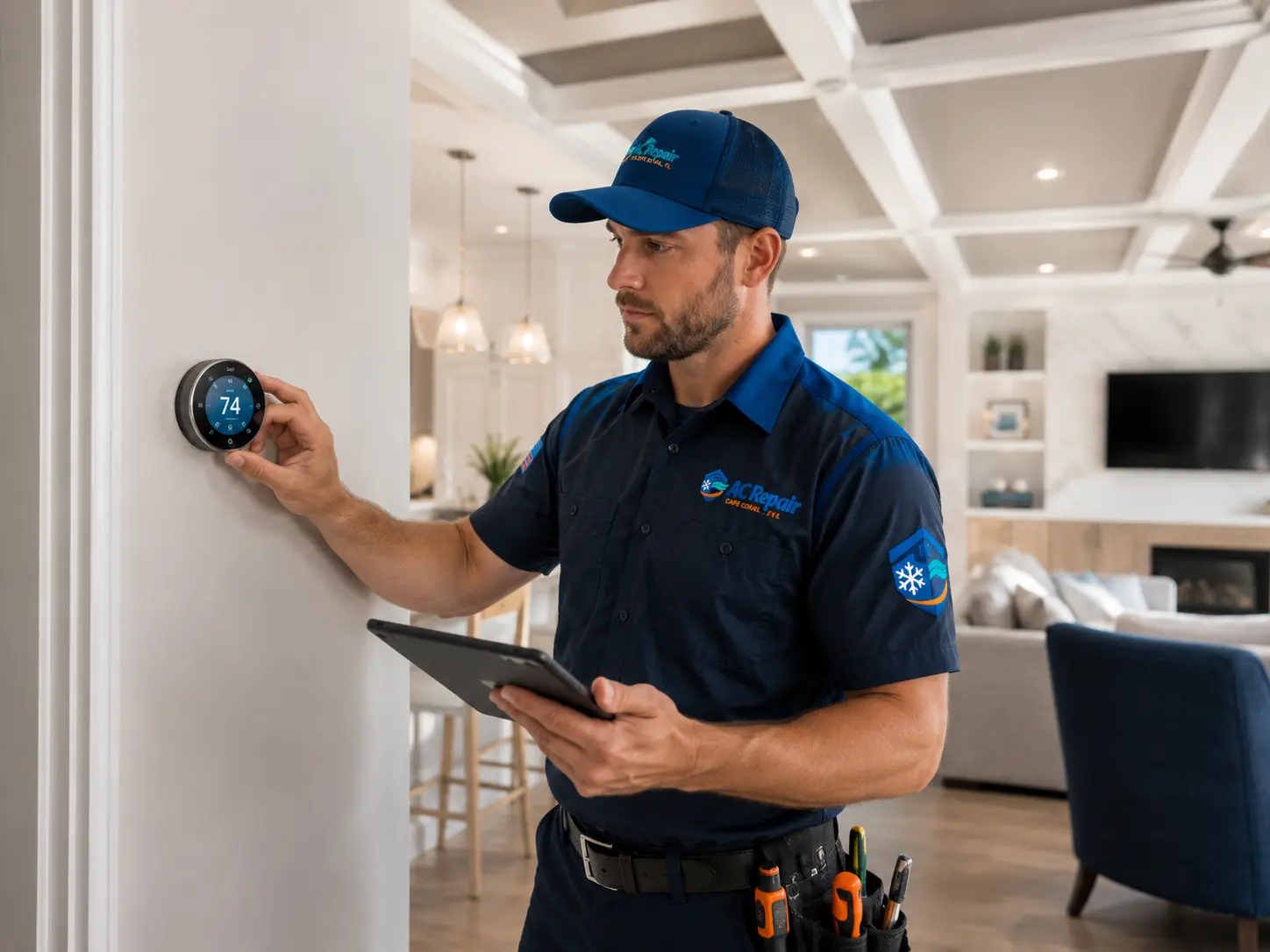
Wiring faults and the C-wire question
Behind every thermostat is a bundle of low-voltage wires — typically labeled R, C, G, Y and W — each carrying a specific control signal to the air handler and condenser. A loose connection, a wire pulled from its terminal during a prior service call, or insulation chewed through in an attic run can cause intermittent operation, a stage that never calls, or a system that runs constantly because a signal is stuck on.
The C-wire deserves particular attention on older homes. Many systems installed before smart thermostats became common were wired without one, since mechanical thermostats needed no continuous power. A smart thermostat installed on that wiring without a C-wire may attempt to draw a trickle of power through another wire in the bundle, which can cause flickering displays, random resets, or the system short cycling in ways that look like an equipment fault but actually originate at the thermostat.
Smart thermostat compatibility
Before swapping in a smart thermostat, the existing wiring needs to match what the new thermostat expects — stage count, heat pump versus straight cool configuration, and whether a C-wire is present or needs to be added. A mismatch doesn't just fail to work; it can cause erratic cycling that's easy to mistake for a failing compressor or control board.
Thermostat problem or equipment problem?
The clearest test is bypassing the thermostat entirely: a technician can jump the low-voltage terminals directly at the air handler or condenser to call for cooling. If the equipment responds correctly to a direct call but not through the thermostat, the fault sits in the thermostat or its wiring run. If the equipment doesn't respond even when called directly, the problem is downstream — a contactor, capacitor, control board or safety switch — and a new thermostat won't fix it.
Short cycling is a good example of why this distinction matters: it can come from a thermostat sensor problem, from oversized equipment, from a dirty coil, or from a refrigerant charge issue. Ruling the thermostat in or out early saves time chasing the wrong system.
Frequently asked questions
01My thermostat display is completely blank. What's wrong?
A blank display usually means it has lost power — a tripped breaker, a blown low-voltage fuse on the control board, dead batteries in a battery-powered model, or a broken C-wire connection on a smart thermostat that needs constant power. Check the breaker and battery compartment first; anything beyond that involves opening the air handler.
02Why does my thermostat show a temperature that doesn't match the room?
A miscalibrated sensor, a thermostat mounted somewhere unrepresentative of the room, or a loose internal connection can all cause a wrong reading. Direct sun on the thermostat body or a nearby heat source like a lamp or supply register are common placement problems that produce a reading warmer or cooler than the actual room.
03What is a C-wire and why does it matter?
The C-wire (common wire) provides continuous low-voltage power to the thermostat. Older systems were wired without one because mechanical thermostats didn't need constant power. A smart thermostat that lacks a proper C-wire may draw parasitic power through other wires, causing erratic behavior, false readings or short cycling.
04How do I know if it's the thermostat or the AC equipment itself?
If the outdoor unit and blower respond correctly when tested at the equipment (a technician can jump the low-voltage terminals directly), but the system doesn't respond to the thermostat, the fault is in the thermostat or its wiring. If the equipment doesn't respond even when called directly, the problem is downstream in the equipment.
05Is my old thermostat compatible with a smart thermostat replacement?
It depends on the wiring available at the wall plate and how the equipment is configured — heat pump, multi-stage, or a system without a C-wire can all complicate a straight swap. Checking the existing wiring against the new thermostat's requirements before installing avoids a non-functioning or erratically behaving replacement.
06Can a bad thermostat cause short cycling?
Yes. A miscalibrated internal temperature sensor, a sticking anticipator on an older mechanical thermostat, or a wiring fault can cause the system to satisfy and re-call for cooling every few minutes even though the house hasn't actually reached setpoint.
Related repair services
Related symptoms
Where we publish AC repair information
Cape Coral, FL
Thermostat acting up?
Tell us what the display is doing and whether the equipment responds, and we'll help narrow down where the fault is.