
Controls + Airflow
Air Handler Repair
- Indoor unit
- Blower + controls
- Attic + closet installs
Quick answer
The air handler is the indoor half of the cooling system: blower motor, evaporator coil, drain pan, filter rack, control board and duct connections all live inside its cabinet. A fault in any one of those components shows up as poor airflow, no airflow, water at the unit, or a system that simply won't respond to the thermostat. Diagnosis means working through each subsystem in order.
The blower motor and wheel
Most residential air handlers use one of two motor types. A PSC motor runs at a fixed speed determined by a run capacitor and a speed tap wired at installation — straightforward to test and replace. An ECM motor is electronically controlled and variable-speed, adjusting output to maintain a target airflow even as static pressure changes; it's more efficient but diagnosed through the control module rather than a simple ohm check, and replacement parts are matched to the specific control programming.
Either motor turns a squirrel-cage blower wheel that moves air across the coil and into the ducts. Over time that wheel collects dust, pet hair and, in a humid climate, biological growth on its blades. A fouled wheel becomes unbalanced — producing noise and vibration — and moves measurably less air even though the motor itself is healthy, which reduces cooling capacity and can contribute to coil icing.
Control board, transformer and relays
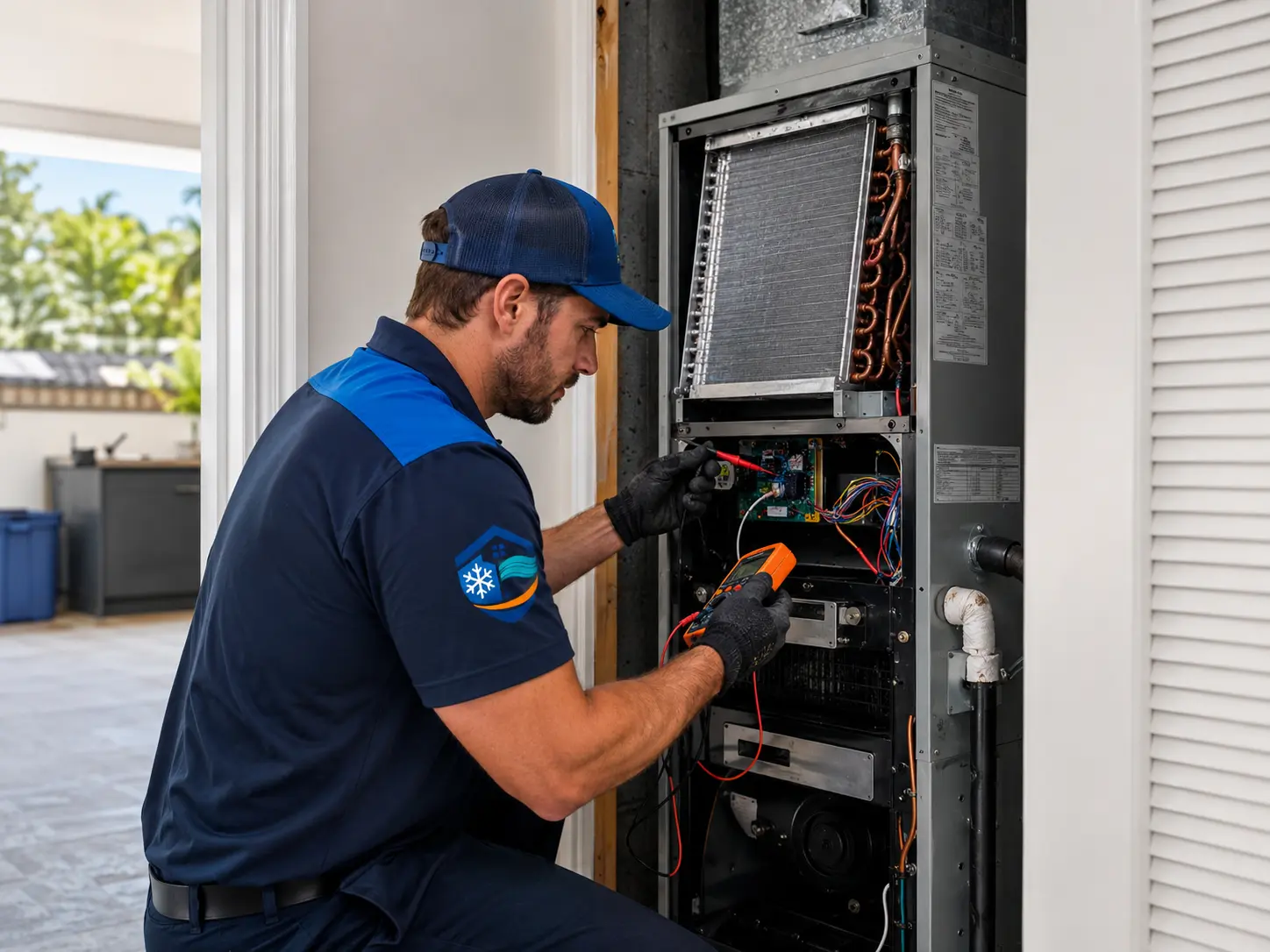
The control board is the air handler's decision point: it reads the thermostat's low-voltage call, sequences the blower at the correct speed and timing, energizes relays for the blower and any auxiliary heat stages, and in many systems coordinates with the outdoor unit. A failed board can leave the blower unresponsive, stuck on, or cycling incorrectly even when every other component tests fine.
The transformer steps line voltage down to the 24V used by the thermostat circuit. A failed transformer takes out thermostat power along with any relay that depends on it — this is one of the more common causes of a completely unresponsive system. Individual relays can also stick or fail, energizing a component that should be off or failing to energize one that should be on.
Drain pan, ducts and static pressure
The drain pan under the evaporator coil catches condensate before it reaches the drain line. Cracked, corroded or improperly sloped pans let water collect instead of draining, which eventually overflows or trips the float switch. Given the condensate volume Cape Coral systems produce, a marginal pan tends to reveal itself quickly.
On the duct side, the blower is only as effective as the ductwork it's pushing against. Undersized returns, crushed flex duct, or too many restrictive fittings raise static pressure — the resistance the blower has to overcome to move air. Sustained high static pressure forces the motor to work harder than it was designed for, shortens its life, and can starve the coil of airflow enough to contribute to freezing.
Filter rack and bypass air
A filter rack that doesn't seal tightly against its frame lets air bypass the filter media entirely, pulling unfiltered dust straight onto the coil and blower wheel and accelerating fouling on both. A gap around the rack can also pull in unconditioned attic or closet air rather than filtered return air, adding heat and humidity load the system wasn't designed to handle.
Attic versus closet installations
Both are common across Cape Coral housing stock. An attic air handler operates in a much hotter ambient environment, which stresses the cabinet insulation and control components, and makes the secondary drain pan and its independent switch especially important — a leak there has nothing below it but ceiling drywall. Attic units are also harder to inspect casually, so a slow drain restriction or a fraying duct connection can go unnoticed longer.
A closet-installed air handler is easier to check and service, but it needs an adequately sized return path. A closet door without sufficient louvering or a return grille undersized for the system's airflow requirement can itself become a static pressure bottleneck, with the same downstream effects on the blower and coil as a duct restriction.
Frequently asked questions
01What's the difference between a PSC and ECM blower motor?
A PSC (permanent split capacitor) motor runs at a fixed speed set by a capacitor and tap selection, and is simpler and cheaper to replace. An ECM (electronically commutated motor) is variable-speed, controlled electronically for better efficiency and airflow consistency, but it's more expensive to replace and diagnosed differently — often through the control board's fault codes rather than a simple continuity test.
02Why is my air handler noisy or vibrating?
A blower wheel that has accumulated dust, pet hair or mold buildup on its blades becomes unbalanced and noisy, and also moves less air for the same motor effort. Loose panels, a failing motor bearing, or debris caught in the wheel are other common noise sources.
03What does the air handler's control board actually do?
It receives the low-voltage call from the thermostat and sequences the blower motor, energizes the appropriate relays, and in many systems manages the electric heat strip stages or communicates with the outdoor unit. A failed board can cause the blower to not start, run at the wrong speed, or never receive the cooling call at all.
04Can duct problems really affect the air handler itself?
Yes. Undersized, crushed, or poorly connected ductwork raises static pressure the blower has to work against. Sustained high static pressure makes the motor run hotter and harder than designed, shortens its life, and can reduce airflow across the evaporator coil enough to contribute to coil freezing.
05Should my air handler be in the attic or a closet?
Both are common in Cape Coral homes. Attic installations run hotter and make condensate drainage and secondary pan monitoring more important because a leak there can damage the ceiling below. Closet installations are easier to access and inspect but need proper return air sizing so the closet door itself doesn't restrict airflow.
06What does a bypassed or damaged filter rack cause?
A filter rack that doesn't seal properly lets unfiltered air bypass the filter and pull dust directly onto the evaporator coil and blower wheel, accelerating fouling on both. It also lets return air leak in from an attic or closet space instead of conditioned living space, which can pull in extra heat and humidity.
Related repair services
Related symptoms
Where we publish AC repair information
Cape Coral, FL
Airflow or indoor-unit noise not right?
Describe what the air handler is doing — noise, weak airflow, water, or no response — and get a clear read on the likely cause.