
AC troubleshooting guide
AC Troubleshooting Guide
- Symptom-by-symptom
- Homeowner-safe checks
- Cape Coral, FL
Quick answer
Most residential AC problems fall into eight recognizable patterns. Find the one that matches what your system is doing, work through the safe checks in order, and stop at the line where the fix requires test equipment or opening energized components.
This guide is not a substitute for diagnosis — it's a way to understand what's likely happening and avoid making a problem worse before help arrives.
Decision tree
Find your symptom
Work through these in order. Many AC failures present with more than one symptom at once — a freezing coil that later leaks water when it thaws, for example — so read the ones that overlap with what you're seeing.
Nothing runs at all
No outdoor unit, no indoor blower, no thermostat response.
Safe checks
- Confirm the thermostat is set to Cool and the setpoint is below room temperature.
- Check the breaker for the AC — reset once if tripped, but do not reset a breaker that trips again immediately.
- Confirm the outdoor disconnect and the indoor service switch are fully seated in the on position.
- Replace thermostat batteries if the display is blank.
Stop and call
Stop and call if the breaker trips again, the thermostat stays dead after fresh batteries, or you'd need to open any electrical enclosure to check further.
Runs but blows warm air
The blower is moving air, but it isn't cold — the cooling side has stopped working even though the fan hasn't.
Safe checks
- Look at the outdoor unit. If the fan isn't spinning and you don't hear the compressor, this is likely electrical (capacitor, contactor) or a tripped high-pressure safety switch.
- Check the filter — a fully blocked filter can starve the coil of airflow badly enough to affect output.
- Confirm nothing is blocking supply vents or return grilles inside the house.
Stop and call
Stop and call if the outdoor unit is silent, humming without spinning, or cycling on and off rapidly. Don't keep running the system — a stalled compressor circuit can trip repeatedly and cause more damage.
Cools weakly
Some cooling happens, but the house never quite reaches setpoint, or it takes far longer than usual.
Safe checks
- Replace the filter if it's visibly loaded — this is the single most common cause of weak output.
- Walk the house and confirm registers are open and not blocked by furniture or rugs.
- Confirm return air grilles are unobstructed; a blocked return starves the whole system of airflow.
- Look at the outdoor coil for visible debris, leaves, or grass clippings packed into the fins.
Stop and call
Stop and call if airflow feels normal at the vents but the air itself isn't noticeably cold, which usually points to a refrigerant or coil problem that needs gauges to diagnose.
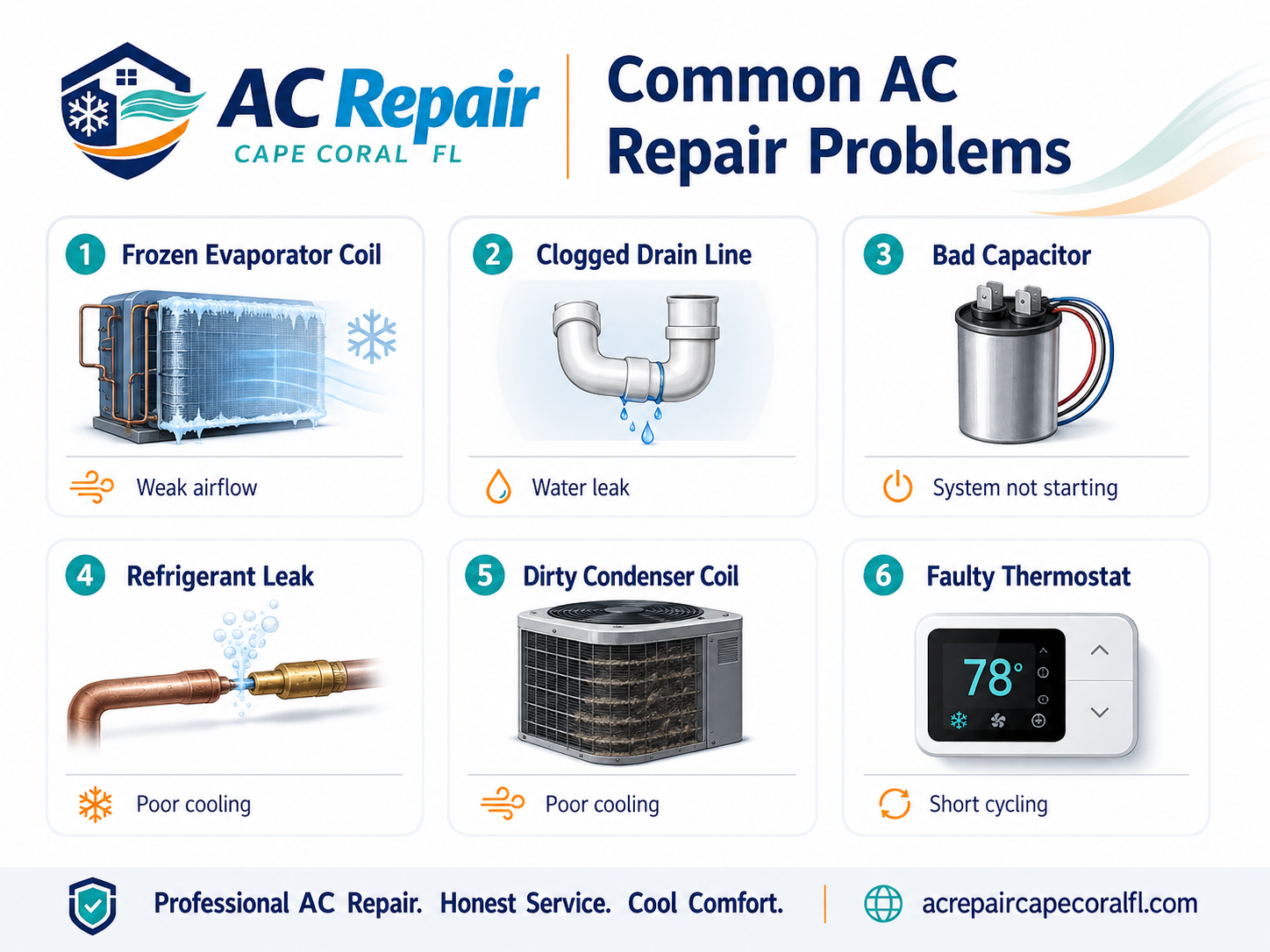
Freezes up
Visible ice on the indoor coil, the refrigerant line set, or frost creeping onto the outdoor service valves.
Safe checks
- Turn the system off immediately and set the fan to run (not auto) to help the ice melt without adding more moisture load.
- Check the filter once accessible — a blocked filter is the most frequent cause of a frozen coil.
- Confirm no return grilles or supply vents are closed off, since restricted airflow anywhere in the system can drop coil temperature below freezing.
Stop and call
Never chip or pry at ice — it risks puncturing the coil or line set. If the coil re-freezes after a fresh filter and clear vents, the cause is likely a refrigerant leak or a weak blower and needs a technician.
Leaks water
Water pooling at the air handler, a stained ceiling below an attic unit, or a drain pan running over.
Safe checks
- Turn the system off to stop producing more condensate.
- Look for a condensate safety switch near the drain pan or line and see if it has tripped — most reset on their own once water recedes.
- If accessible, check the drain line's outdoor termination point for algae buildup or a visible clog.
Stop and call
Stop and call if you can't find or clear the clog yourself, if water keeps returning after the pan is emptied, or if there's already visible damage to drywall or flooring.
Short cycles
The system starts, runs for just a few minutes, then shuts off — repeating over and over without satisfying the thermostat.
Safe checks
- Confirm the thermostat isn't in direct sun, near a supply vent, or otherwise reading a temperature that doesn't match the room.
- Check the filter and coil access panel for obvious airflow blockages.
- Note whether cycling is tied to the outdoor unit tripping on and off or the whole system, which helps narrow the cause.
Stop and call
Short cycling stresses the compressor every time it happens. If a fresh filter and a normally placed thermostat don't resolve it, this needs electrical and refrigerant testing.
Runs noisy
Grinding, screeching, banging, rattling, or a loud hum that wasn't there before.
Safe checks
- Note whether the noise is from the outdoor unit or indoor air handler, and whether it happens at startup, during operation, or at shutdown.
- Check for loose panels or debris rattling around inside the outdoor cabinet — do not remove panels or reach inside.
Stop and call
Any new grinding, screeching, or banging warrants a shutdown and a call. These sounds usually mean a failing motor bearing, a loose or failing component, or a mechanical problem inside the compressor.
Smells off
Musty, moldy, burning, or chemical odors from the vents or the equipment itself.
Safe checks
- A musty smell usually points to moisture and biological growth in the ductwork, drain pan, or coil, and is worth mentioning at your next service visit.
- A burning or electrical smell should not wait — turn the system off at the breaker.
Stop and call
Any burning, hot-plastic, or electrical odor is an immediate stop-the-system situation. Shut off the breaker and call before running it again.
Boundaries
Do not do this
A few tasks come up repeatedly as things homeowners attempt that make a repair harder, more expensive, or genuinely dangerous. None of the following are homeowner tasks:
- Adding refrigerant. It's a regulated substance requiring certification to purchase, and adding it without finding the leak just delays the real fix.
- Handling a capacitor. Capacitors store an electrical charge that can persist even with the system powered off, and discharging one safely takes the right tools and technique.
- Chipping ice off a coil. This risks puncturing the coil or copper lines, converting an airflow problem into a refrigerant leak.
- Bypassing a safety switch. Float switches, high-pressure cutouts, and similar devices exist to stop equipment before it causes water damage or a compressor failure — defeating them removes that protection entirely.
- Pressure washing the outdoor coil. High-pressure water can bend delicate aluminum fins flat, reducing airflow through the coil permanently. A gentle hose rinse from the inside out is the safe version of this task.
Frequently asked questions
01Is there any harm in checking the filter myself?
None. Filter access is designed for homeowners to reach easily, and a fresh filter is one of the most common fixes for weak airflow, icing and reduced cooling. Just power the system off first so nothing tries to run without a filter in place for more than a moment.
02Can I add refrigerant if my gauges say it's low?
No. Refrigerant is a regulated substance that requires certification to purchase and handle, and adding it without finding the leak first just delays the real repair while masking symptoms. If your system needs refrigerant, it has a leak that needs to be located and corrected.
03My outdoor unit is humming but not spinning. Can I touch it?
No. A humming, non-spinning condenser usually means a failed capacitor or a seized motor, both of which are energized and, in the case of a capacitor, can hold a dangerous charge even with the system off. Shut off power at the breaker or disconnect and call for service.
04Should I try to knock ice off a frozen coil?
No. Chipping or prying at ice risks puncturing the coil or copper lines, turning an airflow problem into a refrigerant leak. Turn the system off, set the fan to run for a while to help it thaw, and address the underlying airflow or charge issue afterward.
05How do I reset a tripped condensate float switch?
Most float switches reset themselves once the water level drops, so the real task is clearing whatever caused the water to back up — usually a clogged drain line. If the switch keeps tripping after the line is clear, the float itself or the pan may need attention from a technician.
06What if my AC problem doesn't match any of these patterns?
Symptoms often overlap — a system that's freezing may also be short cycling, for example. Describe everything you're observing (sounds, smells, water, ice, timing) rather than forcing it into one category, and a technician can sort out which failure is primary.
07Is it ever okay to keep running a system that's acting up?
Sometimes, briefly, if the symptom is mild — slightly weak airflow, for instance. But running a freezing, leaking, or electrically abnormal system can turn a simple repair into a bigger one, so when in doubt, shut it down and get it checked before it runs longer.
Related repair services
Related symptoms
Where we publish AC repair information
Cape Coral, FL
Worked through the checks and still stuck?
Describe the symptom and what you've already checked, and get a straight read on what's likely happening next.