Flagship service
AC Repair Cape Coral FL
- Location: Cape Coral, FL
- Phone: 239-423-5617
- Service: Residential cooling repair
Quick answer
AC repair means finding the specific component that failed and correcting it, not swapping parts on a guess. A proper repair visit runs a structured diagnostic across electrical, airflow, refrigerant, drainage and control systems, isolates the failure, repairs it, and verifies the fix under load.
The diagnostic process
Finding the failure before fixing it
Every AC repair starts with the same question: what is the system actually doing? A unit that runs constantly without cooling has a different problem than one that never starts, and both are different from a unit that starts, runs briefly, and shuts back down. That symptom narrows the diagnostic path before a single tool comes out.
From there, a technician works through the system in a deliberate sequence. Line voltage and control voltage get checked first, because a system with no power or a tripped safety device will show symptoms that look mechanical but aren't. Next comes airflow: filter condition, return air path, and blower operation, since restricted airflow across the evaporator coil is one of the most common root causes of cooling complaints in this climate. Temperature split — the difference between the air entering the return and the air leaving the supply — gets measured to judge whether the coil is absorbing heat correctly. Refrigerant circuit pressures get checked against the equipment's rated values, not just "topped off." The condensate drain and float safety switch get inspected, since a tripped switch will shut a system down even though nothing else is wrong. Only after this sequence does a technician commit to a component-level diagnosis.
Failure families
The component groups that fail
Start components
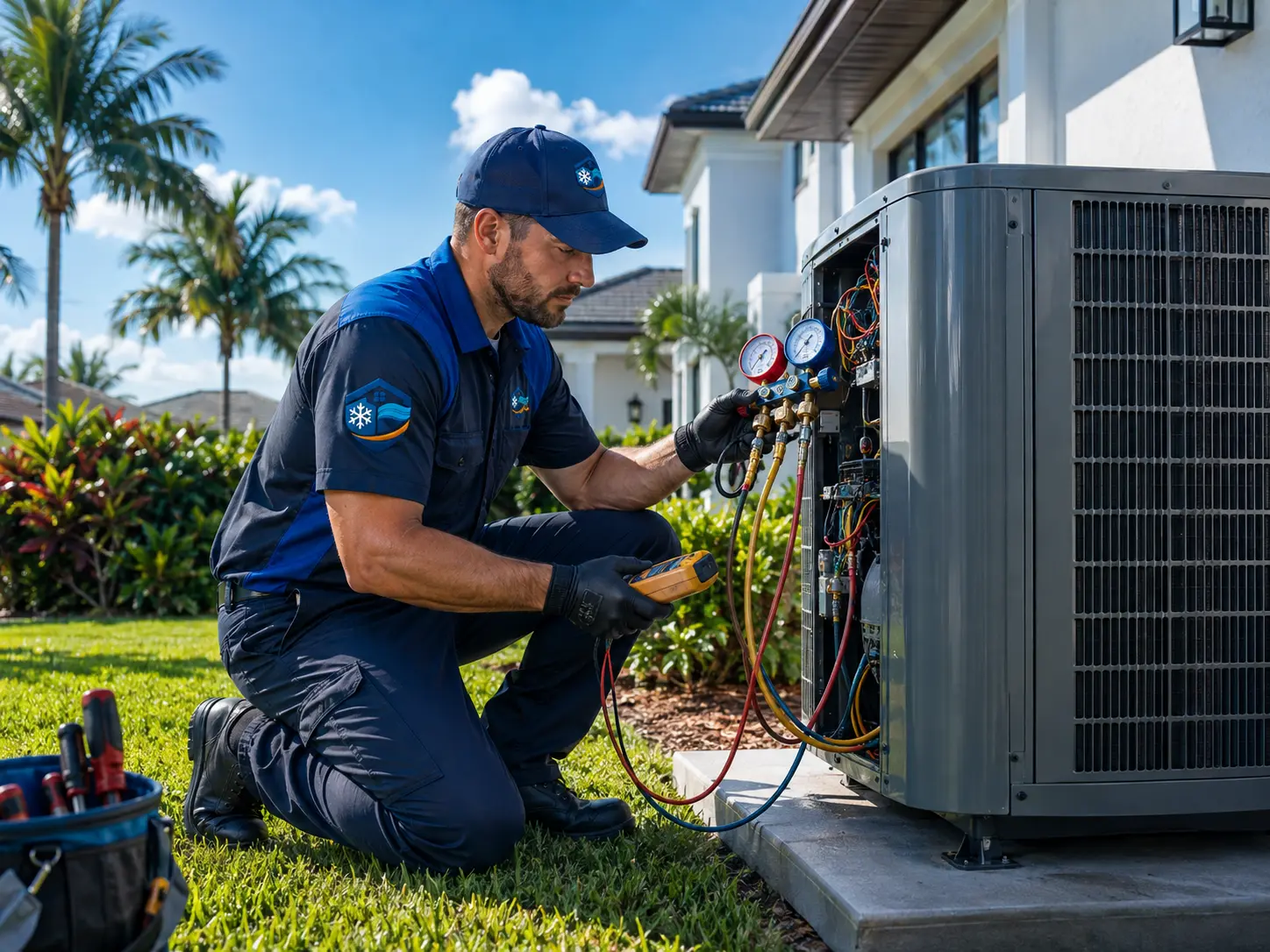
Run and start capacitors, contactors and relays wear out from heat and switching cycles. A weak capacitor causes hard starting, humming, or a compressor and fan that never spin up at all. Cape Coral's near year-round runtime accelerates this wear compared to seasonal climates.
Motors
Blower motors and condenser fan motors fail from bearing wear, winding breakdown, or capacitor-related overheating. A failing blower motor reduces airflow across the coil and can trigger freezing; a stopped condenser fan lets head pressure climb and can trip the compressor's internal protection.
Controls
Thermostats, control boards, transformers, and low-voltage wiring coordinate every stage of a cooling cycle. A fault here can look like a dead system even though the compressor and motors are fully functional — testing the control chain rules this in or out early.
Coils
The evaporator coil absorbs heat indoors; the condenser coil rejects it outdoors. Fouling, physical damage, corrosion, and refrigerant leaks at brazed joints all reduce heat transfer. A corroded outdoor coil is a common finding in canal-side and waterfront Cape Coral properties.
Refrigerant circuit
Leaks at fittings, coils, or the line set drop the refrigerant charge below its design value, which reduces cooling capacity and can freeze the coil. The circuit needs pressure testing and leak location, not simply a refrigerant top-off that fails again later.
Drainage
The condensate drain carries away the water the coil pulls out of humid air — a significant volume in this climate. Algae growth, disconnected sections, or improper pitch cause backups that trip the float switch or overflow into the home.
How central AC works
Why these components depend on each other
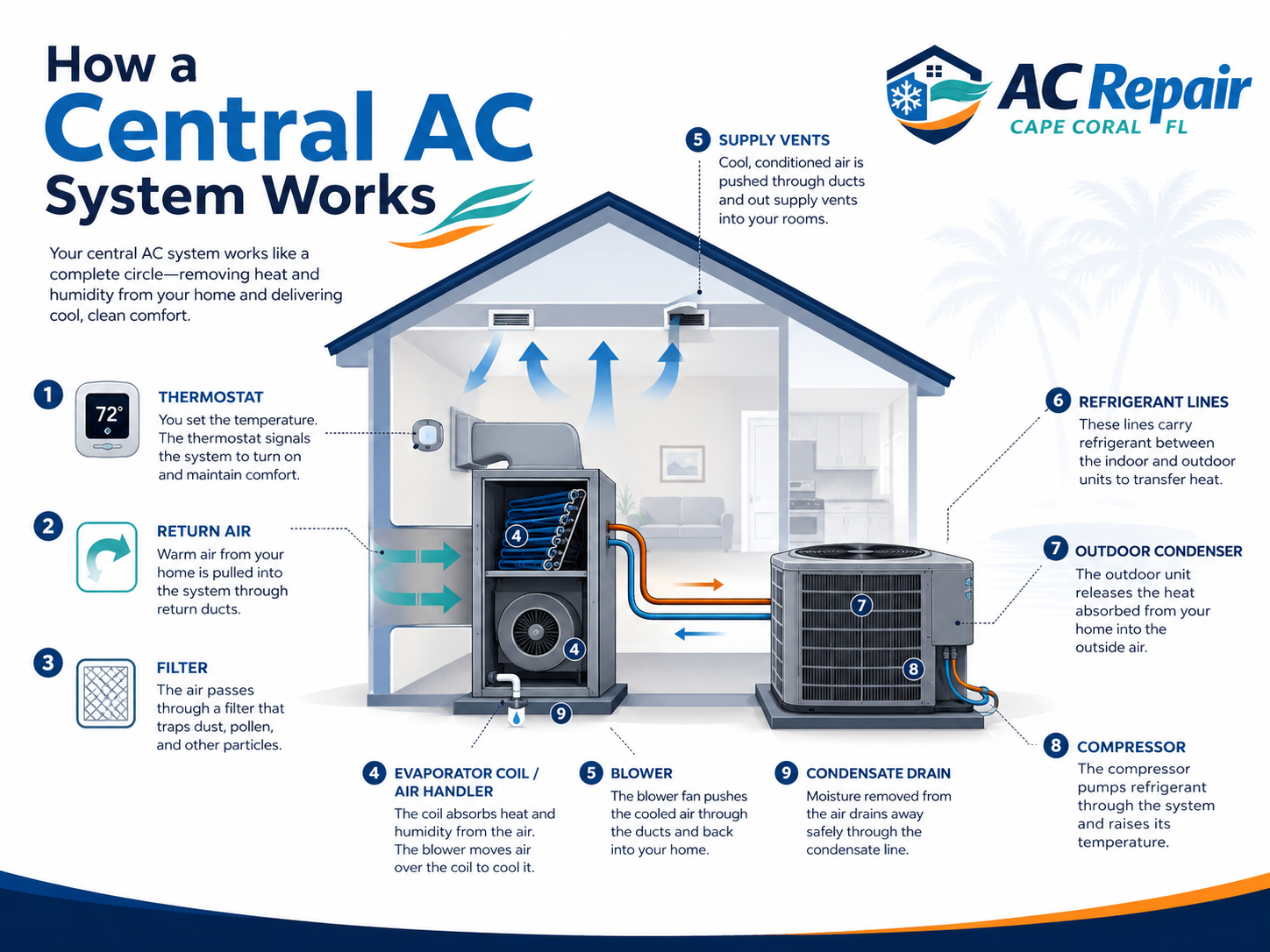
A central AC system is a loop: refrigerant absorbs heat at the indoor evaporator coil, carries it to the outdoor condenser coil, and rejects it outside. The compressor moves the refrigerant and raises its pressure and temperature so heat can be released outdoors even on a hot Cape Coral afternoon. The blower moves house air across the indoor coil, and the condenser fan moves outside air across the outdoor coil.
Because it's a closed loop, a problem in one section shows up as a symptom somewhere else. Restricted airflow at the indoor coil can freeze it. A failed condenser fan raises pressure on the whole circuit. A refrigerant leak anywhere in the loop lowers capacity system-wide. That's why a real diagnostic checks the whole chain rather than stopping at the first plausible cause.
The repair visit
How a repair visit is structured
Symptom review
What the system is doing, when it started, and any recent events.
Diagnostic sequence
Electrical, airflow, coil, drain, and refrigerant checks in order.
Findings explained
The failed component and cause explained before any repair work.
Repair performed
The specific part replaced or corrected, not a general overhaul.
Verification
System rechecked under load once the repair is complete.
What verification after repair means
A repair isn't finished when a part is replaced — it's finished when the system proves it. Verification means running the equipment under normal load and rechecking the numbers that mattered during diagnosis: supply-air temperature against return-air temperature, amp draw on the compressor and fans, cycling behavior over multiple runs, and condensate flow at the drain. If those numbers land where they should, the repair addressed the actual cause. If not, the diagnostic continues rather than closing out the visit on an assumption.
Local conditions
Why Cape Coral systems fail differently
Cape Coral's cooling season runs nearly the entire year, so compressors, motors, capacitors and contactors log far more operating hours annually than the same parts in a seasonal climate. High ambient humidity means these systems remove significant moisture on top of lowering temperature, producing a steady condensate volume that makes drain-related failures common. Outdoor units sit in direct afternoon sun exactly when heat load peaks, and properties near canals or the river see accelerated corrosion on condenser coils, cabinet hardware and electrical contacts from salt-laden air. Storm season adds voltage events that stress start components and control boards, plus debris that restricts outdoor coil airflow after heavy weather. None of this makes repair guesswork acceptable — it makes a structured diagnostic more important.
Frequently asked questions
01What happens during an AC diagnostic visit?
A technician checks the thermostat call and control signals, measures voltage and amp draw at the compressor and blower, checks temperature split across the evaporator coil, inspects airflow and the filter, checks the condensate drain and safety switch, and evaluates refrigerant circuit pressures. The goal is to identify the specific failed component instead of guessing.
02How long does an AC repair usually take?
It depends entirely on the failure. A capacitor or contactor replacement is a short, contained job. A refrigerant leak search, a coil replacement, or a control board fault takes longer because leak locations and wiring faults require methodical testing rather than a single check.
03Will the technician tell me what actually failed?
Yes. A proper repair explains which component failed, why it failed, and whether anything else in the system contributed to the failure, before any repair work is approved.
04Do you fix the AC or just add refrigerant?
Refrigerant is not consumed in a sealed system. If the charge is low, refrigerant is leaking somewhere. Simply adding refrigerant without finding and repairing the leak means the system loses charge again, often within weeks or months.
05What does 'verification after repair' actually check?
After a repair, the system is run under load and rechecked: supply air temperature versus return air temperature, amp draw on the compressor and fans, cycling behavior, and condensate drainage. That confirms the repair corrected the failure instead of masking it temporarily.
06Why do Cape Coral AC systems need more frequent repair than northern climates?
The cooling season runs nearly year-round here, so compressors, motors, capacitors and contactors accumulate far more operating hours per year. High humidity adds continuous condensate load, and coastal salt air accelerates corrosion on outdoor coils and electrical contacts.
07Can I keep running the AC while waiting for repair?
It depends on the symptom. A system that is simply underperforming can often keep running until service. A system with a frozen coil, water at the air handler, or a tripped breaker should be shut off first — continuing to run it risks turning a repairable failure into a more expensive one.
Related repair services
Related symptoms
Where we publish AC repair information
Cape Coral, FL
Your AC shouldn't be a guessing game.
Describe what the system is doing and get a straight explanation of what needs to happen next.