
AC repair FAQ
AC Repair Frequently Asked Questions
- 8 topic groups
- Cape Coral, FL
- Straight answers
Quick answer
This page collects the questions Cape Coral homeowners ask most about AC symptoms, electrical faults, refrigerant, drainage, cost, maintenance, local climate, and working with a technician.
Each answer links to a deeper page where the topic gets a full explanation — use this as a fast index, and follow the links for the complete picture.
Reference
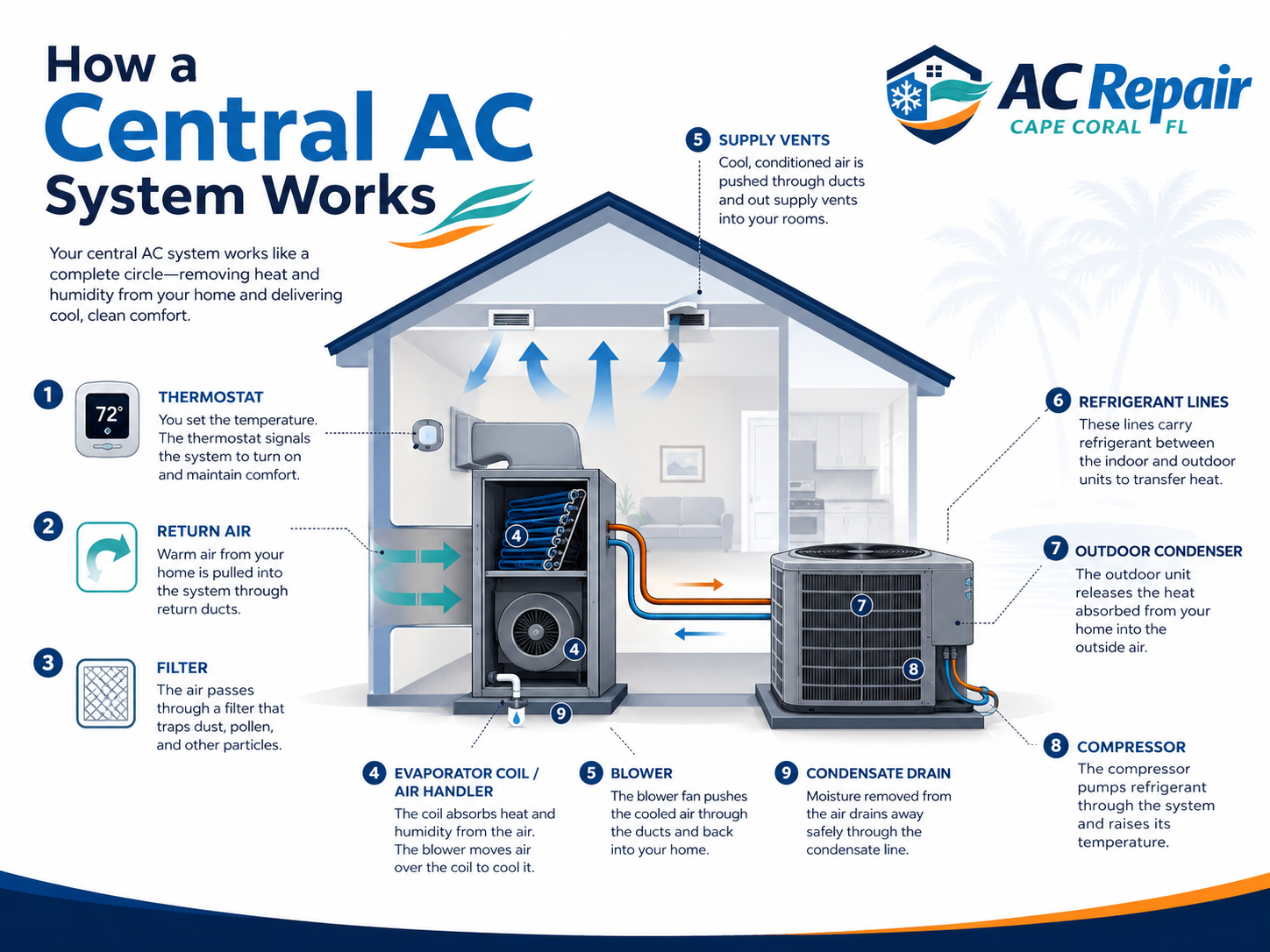
How central AC works
Many of the questions below make more sense with the basic system layout in mind: an indoor evaporator coil and blower, an outdoor condenser and compressor, refrigerant lines connecting them, and a condensate drain carrying away the moisture pulled from the air.
Symptoms
01Why is my AC running but not cooling the house?
The blower can move air even if the cooling side has stopped working, which usually points to a stalled compressor, lost refrigerant charge, or a coil that's frozen. See the AC not cooling page for the full breakdown of causes.
02Why is my AC blowing warm air?
Warm supply air means the outdoor unit isn't rejecting heat properly — often an electrical fault stopping the compressor or fan, or a refrigerant charge too low to cool effectively. Details are on the AC blowing warm air page.
03Why does my AC have ice on it?
Ice forms when the indoor coil gets too cold, almost always from restricted airflow (a dirty filter, closed vents) or low refrigerant charge. Turn the system off and let it thaw rather than chipping at the ice — see the frozen AC page.
04Why does my AC short cycle?
Starting and stopping every few minutes instead of running a full cycle stresses the compressor and points to a thermostat placement issue, an airflow restriction, or an electrical fault forcing early shutdown.
05Why is my AC making a new noise?
Grinding or screeching usually means a failing motor bearing; banging can mean a loose or failing internal component. New noises are worth shutting the system down for and having checked rather than waiting.
Electrical
01Why won't my AC turn on at all?
Check the thermostat setting and batteries, then the breaker, then the outdoor disconnect and indoor service switch. If those are all fine and it still won't start, the cause is likely a failed capacitor, contactor, or control board. See AC not turning on.
02What does it mean when my outdoor unit hums but doesn't spin?
This is a classic sign of a failed run capacitor or a seized fan motor. The system is receiving power but the fan can't start moving on its own. Shut off power at the disconnect and don't attempt to spin the fan by hand.
03Can a capacitor really stop cooling from working entirely?
Yes. A capacitor provides the electrical push a compressor or fan motor needs to start. When it fails, the motor may hum without starting or may not respond at all, halting cooling even though the rest of the system is intact.
04Is a tripping breaker always a compressor problem?
Not always, but a breaker that trips repeatedly on the AC circuit should not be reset over and over. It can indicate a failing compressor drawing excess current, a short in the wiring, or another electrical fault that needs testing before the system runs again.
05What is a contactor and why does it fail?
A contactor is the switch that sends power to the outdoor unit's compressor and fan. Its contacts pit and burn over years of daily cycling, especially in a climate where the system runs almost continuously, eventually failing to close and stopping the unit from starting.
Refrigerant
01Can I just add refrigerant if my AC is low?
No. Refrigerant circuits are sealed in normal operation, so a low charge always means there's a leak somewhere. Adding refrigerant without finding and repairing the leak only masks the symptom temporarily. See refrigerant leak repair.
02How do I know if I have a refrigerant leak?
Common signs include weak cooling that gradually worsens over weeks, ice forming on the indoor coil or line set, and a hissing sound near the refrigerant lines. Only pressure testing can confirm and locate the leak precisely.
03Does my system need a specific refrigerant type?
Yes — the refrigerant type is specific to your system's design and generally tied to when it was manufactured. A technician identifies the correct type before any service that involves the refrigerant circuit.
04Is refrigerant handling regulated?
Yes. Purchasing and handling refrigerant requires certification, which is one reason it isn't a homeowner task even if you have gauges to check pressure.
Drainage and humidity
01Why is water leaking from my air handler?
The most common cause is a clogged condensate drain line backing water up into the pan until it overflows. Cracked drain pans and disconnected drain lines are other possibilities. See AC leaking water.
02Why does my drain line keep clogging?
Condensate lines carry a steady stream of moisture, and Cape Coral's humidity keeps that moisture flowing nearly year-round, which is ideal conditions for algae and biological growth to build a clog inside the line over time.
03What is a condensate float switch?
A safety device that shuts the system down when water rises too high in the drain pan or line, preventing an overflow from reaching your ceiling or floors. Most reset automatically once the water clears, but repeated tripping means the underlying clog needs attention.
04Why does my house feel humid even when the AC is running?
Short, frequent cooling cycles cool the air quickly but don't run long enough to remove much moisture, since dehumidification is a gradual process. A wide thermostat swing, oversized equipment, or restricted airflow can all produce this pattern.
Cost and decisions
01Why can't I get a price over the phone?
The same symptom can come from several different failures with very different scopes of repair. A number given before diagnosis is a guess. See the AC repair cost factors page for the variables that actually determine scope.
02What determines how much a repair involves?
The failed component, system age and part availability, how hard the equipment is to access, whether refrigerant work is involved, and how much diagnostic time is needed to isolate the cause.
03Should I repair or replace my system?
It depends on the system's age, the nature of the failure, and how many prior repairs it's needed. The repair vs. replace guide walks through how to weigh those factors.
04Is it worth getting a second opinion?
Yes, especially for a major repair. Compare the diagnosis and proposed scope, not just a final number — two accurate diagnoses of the same failure should describe a similar scope of work.
Maintenance
01How often should I change my AC filter in Cape Coral?
Roughly every 30 days for a standard filter, since the system runs nearly year-round here. Homes with pets or heavy dust often need checks every two to three weeks. Full detail is in the maintenance guide.
02Can I clean my own outdoor coil?
Yes, with a gentle garden hose spray from the inside out. Never use a pressure washer — it can flatten the coil's aluminum fins and permanently reduce airflow.
03What does a professional tune-up check that I can't?
Refrigerant pressures, electrical components under load, the condensate safety switch, and coil condition — all of which require opening the equipment and using test instruments.
04How much clearance does my outdoor unit need?
At least two feet of open space on all sides, free of landscaping, stored items, and debris buildup, to allow proper airflow across the coil.
Local Cape Coral conditions
01Why does Cape Coral's climate stress AC systems more than other places?
The combination of near-year-round cooling demand and consistently high humidity means longer run hours, heavier condensate volume, and a bigger latent (moisture-removal) load than systems in drier climates typically face.
02Does salt air really affect AC equipment here?
Yes, particularly for homes near canals and the river. Salt-laden air accelerates corrosion on outdoor coils and cabinets over time, which is part of why rinsing the coil regularly and choosing corrosion-resistant components matters more in coastal areas.
03What should I check on my AC after a storm?
Confirm the outdoor unit is level, free of standing water and debris, and undamaged before restoring power, and watch for unusual noise or a tripped breaker on the first restart. Full guidance is in the maintenance guide's storm-season section.
04Does afternoon sun on my condenser matter?
Yes. A condenser working to reject heat is less efficient when it's also absorbing direct solar gain all afternoon. Shade from a structure (not shrubs that block airflow) can help, though clearance around the unit still comes first.
Working with a technician
01What should I describe when I call about a problem?
Everything you're observing: sounds, smells, water, ice, timing (does it happen at startup, after running a while, only in the afternoon), and anything you've already checked. More detail up front speeds up diagnosis.
02What will a technician actually do during a diagnostic visit?
Check electrical readings under load, refrigerant pressures if relevant, airflow at the coil and vents, and any safety switches, working systematically toward the specific failed component rather than guessing.
03Should I be present during the repair?
You don't have to be, but it's reasonable to ask the technician to walk you through what they found and what they're proposing before work begins, especially for a repair beyond a simple part swap.
04What questions should I ask before agreeing to a repair?
What component failed and how was it confirmed, is this a single-visit repair, does it involve refrigerant work, and does warranty status apply to any part of it. The cost factors page has the full list.
Go deeper
Related guides and services
Every answer above points toward a fuller resource. Here are the most useful starting points:
Related repair services
Related symptoms
Where we publish AC repair information
Cape Coral, FL
Still have a question about your system?
Describe what's going on and get a straight, specific answer instead of a generic one.