Refrigerant + coil repairs
Evaporator Coil Repair
- Indoor coil
- Fouling, corrosion, freezing
- Cape Coral, FL
Quick answer
The evaporator coil is the indoor component doing the actual work of cooling and dehumidifying your home's air. Problems here usually show up as reduced cooling, ice on the coil or line set, or humidity that never quite feels controlled.
Fouling, restricted airflow, and corrosion are the main threats to this coil, and the right fix ranges from a cleaning to a full replacement depending on what's actually wrong.
Fouling from bypassed filter air
The filter's job is to keep dust and debris off the evaporator coil, not just protect indoor air quality. When a filter loads up with debris, air resistance across it increases, and some installations allow a portion of return air to bypass the filter around its edges or through gaps in the frame rather than push through the clogged media. That bypassed air carries dust straight to the coil.
Once dust accumulates on the coil fins, it acts as insulation, reducing how effectively the refrigerant inside can absorb heat from the air passing over it. The coil has to run colder to compensate, which sets up the conditions for freezing, and cooling capacity and dehumidification both suffer even before ice forms.
Biological growth and formicary corrosion
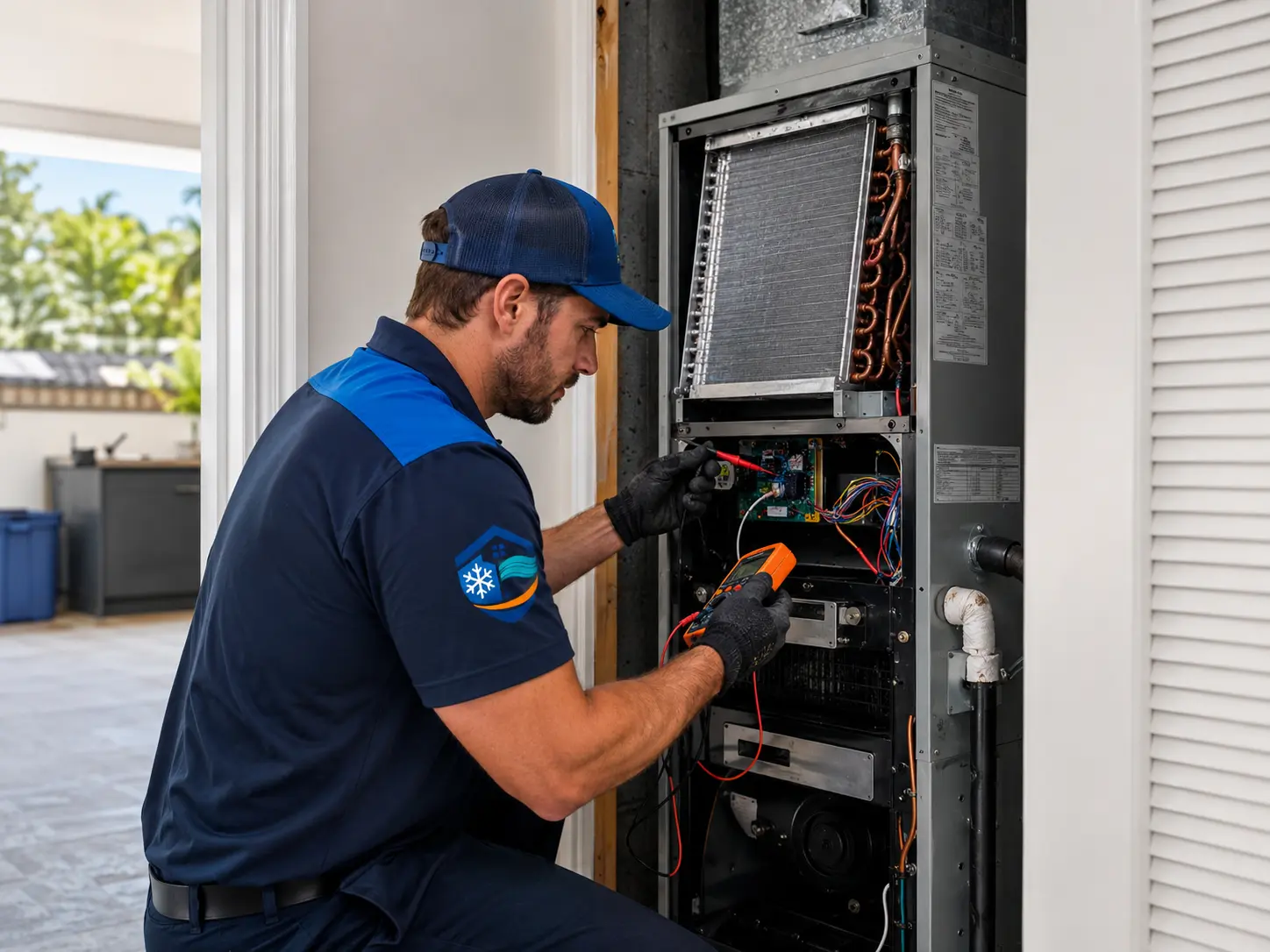
The coil sits cold and wet with condensation for most of a Cape Coral cooling day, which is an ideal environment for mold and biological growth wherever organic material has settled on the fins. Growth restricts airflow through the coil, can contribute to musty odors coming from the supply registers, and adds to indoor air quality concerns beyond the cooling performance itself.
A more serious threat is formicary corrosion — a pattern of microscopic pinhole leaks that tunnel through copper tubing, often linked to certain organic acid vapors reacting with the copper surface over time. These leaks are frequently small and slow, showing up first as a gradual loss of cooling capacity rather than an obvious puddle or hiss, and they can be hard to pinpoint without dye injection or electronic leak detection.
Freezing and restricted airflow
When airflow across the coil is restricted — by a dirty filter, closed or blocked return grilles, a weakening blower motor, or dirty coil fins — the coil surface temperature drops low enough that condensation on it freezes instead of draining away. Once ice starts forming, it further restricts airflow, compounding the problem until the coil can be encased in a solid block of ice.
Low refrigerant charge from a leak produces the same result through a different mechanism: with less refrigerant circulating, the coil runs at a lower pressure and temperature than it should for the airflow passing over it. Either cause needs to be identified and corrected, or the freezing will recur as soon as the ice melts and the system runs again.
Cleaning vs. replacement, and access
A coil fouled mainly by surface dust or moderate biological growth can typically be cleaned in place using appropriate coil cleaning agents and rinsed, restoring most of its original heat transfer performance. A coil with confirmed pinhole leaks, heavily corroded or crushed fins, or fouling severe enough that cleaning can't restore adequate airflow usually needs to be replaced instead.
Access matters for either job. Many Cape Coral homes have the air handler installed in an attic or a compact interior closet, which limits working space and, in attic installations, adds significant heat exposure during the job. Removing an evaporator coil cabinet in these settings takes more care and time than a garage-mounted unit with open clearance on all sides.
Humidity performance impact
A coil that's fouled, iced, or undercharged doesn't just cool less — it dehumidifies less effectively too, since moisture removal depends on air staying in contact with a cold coil surface long enough to condense. In Cape Coral's humid climate, a coil problem often shows up first as a house that feels clammy or "not quite cool enough" well before it stops cooling altogether.
Frequently asked questions
01What does the evaporator coil do?
It's the indoor coil where refrigerant absorbs heat and moisture from the air passing over it. That's the actual cooling and dehumidifying happening in your home — everything else in the system exists to support this coil doing its job continuously.
02How does a dirty filter damage the evaporator coil?
A loaded filter forces some air to bypass it or restricts airflow across the coil overall. Either way, less air moves across the coil surface, which lets the coil run colder than it should. A colder coil is more likely to ice over, and reduced airflow also allows dust that does get through to settle and build up on the coil fins over time, insulating them and further reducing heat transfer.
03What is formicary corrosion?
It's a pattern of microscopic, ant-tunnel-like pinhole leaks that form in copper tubing over time, caused by certain organic acid vapors reacting with the copper surface, often related to indoor air quality factors like some building materials, cleaning products, or adhesives. It results in slow refrigerant leaks from the coil that can be difficult to see without dye or electronic detection.
04Why does mold or biological growth happen on the coil?
The coil surface is cold and constantly wet with condensation for much of the day, which is an ideal environment for biological growth if organic debris — dust, skin cells, airborne particulate — accumulates on the fins. Growth can restrict airflow, contribute to odors, and affect indoor air quality, in addition to reducing coil efficiency.
05Can a frozen evaporator coil be cleared and just run again?
The ice itself needs to melt off fully before restarting, usually by running just the blower fan with cooling off for a few hours. But freezing is a symptom of an underlying airflow or refrigerant problem, so the system will ice over again unless that root cause — a dirty filter, closed returns, weak blower, or low refrigerant charge — is identified and corrected.
06Is cleaning a coil enough, or does it eventually need replacement?
A coil fouled mainly with surface dust and light biological growth can often be cleaned in place and returned to good condition. A coil with pinhole leaks from corrosion, physical damage, or heavy long-term fouling that's degraded the fins may need replacement instead, since cleaning can't repair a leak or restore crushed or corroded fin surfaces.
07Why is evaporator coil access sometimes difficult in Cape Coral homes?
Many homes here have air handlers installed in attics or small interior closets, which limits the space available to access, service, or remove the coil cabinet. Attic installations in particular add heat exposure for anyone working on the unit and can make coil removal a more involved job than a garage or basement installation elsewhere.
Related repair services
Related symptoms
Where we publish AC repair information
Cape Coral, FL
Coil icing up or cooling feels weak?
Get the evaporator coil inspected before ice or corrosion turns a cleaning job into a replacement.