
Ice on the system
Frozen AC: Ice on the Coil or Line Set
- Location: Cape Coral, FL
- Phone: 239-423-5617
- Symptom: Ice on coil/lines
Quick answer
Ice on the evaporator coil or the copper line set means the coil's surface has dropped below freezing, almost always from restricted airflow across the coil or a low refrigerant charge. Turn the system off and let the ice fully melt with the fan running before doing anything else — never chip or scrape ice off, since that risks puncturing the coil or line and repeated freezing can seriously damage the compressor.
Why it freezes
The physics of a coil going below freezing
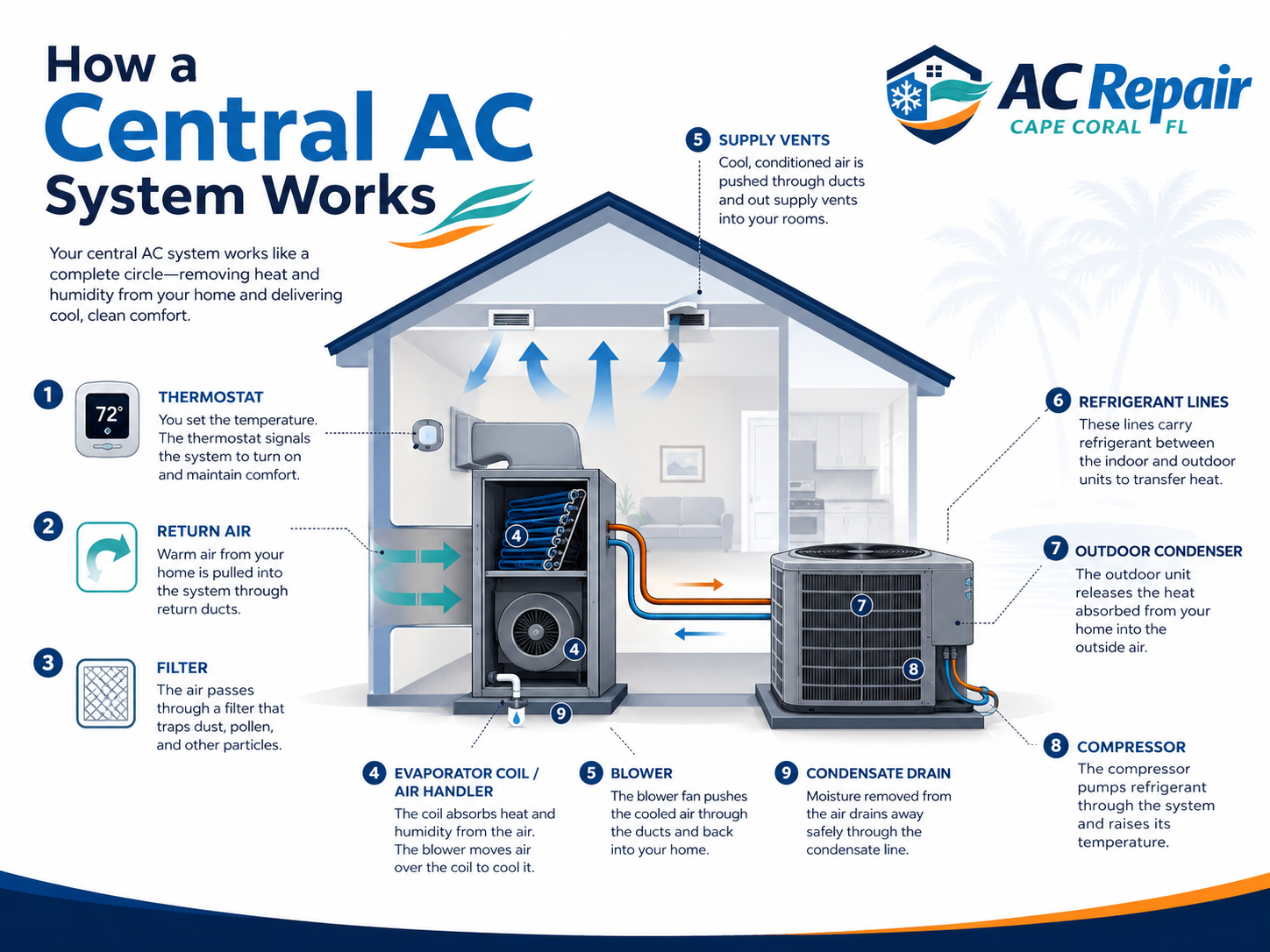
An evaporator coil is designed to run cold — typically somewhere in the high 30s to low 40s Fahrenheit at the surface — while a steady volume of warmer return air passes across it. That temperature is cold enough to pull heat and humidity from the air without dropping below freezing, because the moving air constantly delivers new heat to the coil surface.
Two things disrupt that balance. First, reduced airflow: if less warm air reaches the coil, there's less heat arriving to keep its surface above freezing, so it drifts colder and colder until moisture in the air condenses and freezes directly onto the fins instead of draining away as liquid. Second, low refrigerant charge: with less refrigerant in the circuit, the remaining refrigerant expands and absorbs heat differently than designed, often producing a coil surface that's colder than normal even with airflow intact.
Once ice starts forming, it makes its own problem worse. Ice narrows the gaps between fins that air needs to pass through, which further restricts airflow, which drops coil temperature further, which grows more ice. Left alone, a small patch of frost can progress to a fully solid block of ice across the coil face and down the line set within hours.
Airflow vs. charge
Telling the two causes apart
Airflow-restricted freezing usually has an identifiable upstream cause: a heavily loaded filter, closed supply registers in multiple rooms, return grilles blocked by furniture, or a blower motor that's weakened or failed. This pattern often starts as frost at the edges of the coil, where airflow is naturally thinner, before spreading across the whole face.
Low-charge freezing tends to show up alongside other refrigerant symptoms even before ice is visible: reduced cooling capacity, longer runtimes, and a shrinking temperature split between return and supply air. Ice from a charge problem is often more uniform across the coil and can extend down the suction line running back to the outdoor unit, sometimes visible as frost on the larger of the two copper lines at the condenser.
In practice, distinguishing the two reliably takes a technician's airflow measurement and refrigerant pressure readings, since a coil that's been iced for a while can show characteristics of both by the time it's caught — the ice itself becomes an airflow restriction regardless of what started it.
Safe thaw procedure
What to do, and what never to do
Turn the thermostat off so the compressor stops running, but if your thermostat has a fan-only setting, run the blower fan on its own. Moving room-temperature air across the coil melts ice steadily and evenly from the inside out, which is far faster and safer than waiting for ambient heat alone to do it. A heavily iced coil can take several hours to melt completely — don't rush it or assume a lightly frosted appearance after thirty minutes means it's clear.
Place towels or a shallow pan near the air handler to catch melt water, since a fully iced coil holds more water than people expect, and it needs somewhere to go besides the floor. Once the coil is completely clear of ice — not just frost-free on the visible front face — the system can be restarted, but restarting while any ice remains risks the same damage the freeze-up was already causing.
Never chip or scrape the ice
The fins on an evaporator coil are thin aluminum, and the tubing behind them is soft copper. Both are easy to puncture with a screwdriver, ice pick, or similar tool used to speed up thawing. A punctured coil turns a freeze-up into a refrigerant leak, which usually means coil repair or replacement rather than a straightforward fix. Patience with a fan-only thaw costs time; force costs a coil.
Compressor risk
Why repeated freezing threatens the compressor
The compressor is built to compress refrigerant vapor — a compressible gas. It is not built to compress liquid, which doesn't compress the same way and can cause severe mechanical shock inside the compressor when it arrives in liquid form. A restricted or icy coil disrupts the normal evaporation process, so refrigerant can return toward the compressor partially or largely as liquid instead of vapor, a condition technicians call slugging or floodback.
A single freeze-up handled correctly — full thaw, then diagnosis of the cause — rarely causes lasting harm. The real risk comes from running the system repeatedly through freeze-and-thaw cycles without ever correcting the airflow or charge problem behind it, or from restarting the system with ice still present on the coil. Each cycle that pushes liquid refrigerant back toward the compressor increases the chance of internal damage that ultimately requires compressor replacement — a far larger repair than the airflow or charge issue that started it.
Frequently asked questions
01Why does an air conditioner freeze up in the first place?
The evaporator coil normally runs cold enough to pull heat and moisture from passing air without dropping below freezing on its surface, because a steady volume of relatively warm return air keeps the coil's surface temperature up. If airflow across the coil drops, or refrigerant charge is low, the coil surface can fall below 32°F, and moisture in the air condenses and freezes directly onto the fins.
02How can I tell if it's an airflow problem or a refrigerant problem?
Airflow-related freezing often follows an obvious restriction — a badly loaded filter, closed supply or return vents, a failing blower motor — and tends to start at the coil's edges. Refrigerant-related freezing is often more uniform across the coil and shows up alongside reduced cooling capacity and a shrinking temperature split even before ice appears. Both usually require a technician's pressure and airflow measurements to confirm.
03Is it okay to chip the ice off the coil to speed things up?
No. Chipping or scraping ice risks puncturing the thin aluminum fins or the copper tubing behind them, which turns a freeze-up into a refrigerant leak requiring coil repair or replacement. Ice needs to be melted, not removed by force.
04What's the right way to thaw a frozen coil?
Turn the thermostat to Off but leave the blower fan running on its own if your thermostat allows a fan-only setting, since moving room-temperature air across the coil melts the ice far faster and more evenly than letting it sit. Expect this to take several hours for a heavily iced coil. Place towels or a pan to catch the melt water, since it can be substantial.
05Can I run the compressor while there's still ice on the coil?
No. Running the compressor against a partially or fully ice-blocked coil forces it to operate against airflow it wasn't designed to work without, and can push liquid refrigerant back into the compressor instead of vapor — a condition that causes serious internal damage. Let the coil fully thaw before running the system again.
06Why does repeated freezing damage the compressor specifically?
The compressor is designed to compress refrigerant vapor, not liquid. A restricted or icy coil doesn't let refrigerant absorb heat properly, so instead of returning to the compressor as vapor, it can arrive partially or mostly liquid — a condition called slugging or floodback, which can bend or shatter internal compressor components on impact within a very short time.
07My AC keeps freezing every few days — what does that suggest?
Recurring freezing points to an ongoing cause, not a one-time fluke: a persistently restricted filter, a low and slowly leaking refrigerant charge, a failing blower, or a duct or vent configuration that starves the coil of airflow. Thawing it out repeatedly without addressing the underlying cause risks compressor damage over time.
Related repair services
Related symptoms
Cape Coral, FL
Your AC shouldn't be a guessing game.
Describe what the system is doing and get a straight explanation of what needs to happen next.